Showing posts with label infrared. Show all posts

Wednesday, 11 May 2016

The Serpens South Cluster

Continuing our series on nearby star forming regions that are interesting and important to the history of astronomy I want to turn this week to one of the most recently-discovered regions, the Serpens South Cluster.

Serpens South is not as famous as some of the other nearby star regions such as Taurus and Ophiuchus, predominantly because it was only discovered in the last decade. The cluster is very faint in the optical part of the spectrum because it is still heavily embedded within its molecular cloud, so it wasn't seen by previous surveys that were predominantly performed in the optical part of the spectrum. Furthermore, because the Serpens and Aquila regions of the Galactic plane appear relatively unpopulated in young stars, astronomers hadn't studied the area in much detail.


The vicinity of the Serpens Molecular Cloud as
seen on inverted Deep Sky Survey plates.  The
presence of the molecular cloud is seen from its
obscuration of background stars (Credit: Eiroa et al. 2008).
The wider region first came to prominence in the 1970s when a dark cloud was discovered in the vicinity of the bright star VV Ser near the Aquila Rift (a dark cloud of gas and dust that extends along the Galactic plane in this area of the sky). The image to the left shows the night sky in the vicinity of the Serpens Molecular Cloud where its presence can be seen by the lower density of stars. The density of stars appears lower towards the molecular cloud because dust in the cloud obscures the starlight from stars behind the cloud.

A number of small bright nebulae were identified in the area at this time, including Sharpless 68 and the Serpens Reflection Nebulosity, both illuminated by nearby bright young stars.

South of this region lies the Westerhout 40 (W40) HII region, a modest cloud of ionised gas thought to be at a distance of 1500 light years (500pc). The HII region is the visible part of a larger star forming region where stars of all masses are currently forming including O and B-type stars, making this one of the nearest regions where O and B stars are in the process of forming.

Map of the dark clouds in Serpens that form part of the Aquila Rift. The main part of the cloud
is shown in the grey rectangular box, which includes the W40 region, the Serpens South Cluster
(the white star), and the HII region Sh2-62. The Galactic Plane can be seen across the bottom-left
corner of the image. The earlier image covers the region around Serpens Main and Serpens
NH3 at the top of the image (Credit: Bontemps et al. 2010).

When this area of the sky was observed by the Spitzer Space telescope in 2006 astronomers discovered a cluster of stars previously unknown, highly embedded within the molecular cloud and visible only to infrared telescopes such as Spitzer. The cluster is very close to the W40 HII region, as can be seen on the map of the region shown above. It was soon dubbed the Serpens South Cluster, and since then it has been the focus of considerable study.

The Serpens South Cluster as seen by the
Spitzer Space Telescope
(Credit: Spitzer/NASA)
The kinematics of the gas associated with the cluster are very similar to the gas surrounding W40, suggesting that the two structures are part of the same star forming complex and are likely at the same distance. A distance of 1500 light years is also in good agreement with that recently obtained from radio parallax measurements.

Early studies, primarily with the Spitzer Space Telescope (see image to the right) uncovered a cluster of about 50 stars, of which at least 35 were still in the process of forming, suggesting that the cluster is very young. Later studies in the far-infrared with ESA's Herschel Observatory detected even more highly embedded sources at even earlier evolutionary stages, providing evidence for even younger protostars still in the process of collapsing to form stars.

Given its youth, the density of the cluster is very high, with at least a few hundred stars per square parsec on the sky. This suggests that either the stars formed in a very dense and clustered state (as we see them now) or that clusters like this can form very quickly out of stars that form in a low density distribution. This is one of the key questions astronomers are trying to answer when they study young star clusters.

The infrared observations have also revealed an intricate network of filaments emanating from the cluster with a hub-like morphology. These filaments are thought to play an important role not just in how stars form and build up their masses, but also in how star clusters grow to their present sizes so quickly. Collisions between filamentary structures in molecular clouds may play a critical role in the formation of such dense clusters.

Studies of young and dense clusters such as Serpens South are important for understanding how young star clusters form and how this is related to the formation of stars within them. It seems that the two processes are critically connected and so to study one we must also study the other!

Thursday, 21 January 2016

The nearest site of dense star formation, the ρ Ophiuchi Molecular Cloud

A few months ago I talked about the Taurus Molecular Cloud, a prominent and well-studied site of active star formation, which also has the privilege of being the closest such region to us. It isn't the only nearby region of star formation though, and this week I want to talk about another well-studied nearby region called the ρ Ophiuchi (pronounced rho oh-fee-ook-eemolecular cloud.

ρ Ophiuchi is not much further away than the Taurus Molecular Cloud, lying at a distance of 400 light years from us (120 parsecs), but one of its truly special features is that it is visible from both hemispheres. Due to the orbit and rotation of the Earth, astronomical objects visible from one hemisphere are often not easily seen from the other hemisphere, simply because the Earth does not spin into a position where they could be observed.

This presents a difficulty for astronomers because astronomical observatories can therefore only observe about half the sky. Telescopes and radio antennae in the Southern hemisphere can only observe the Southern sky, and vice versa (this isn't strictly true as it depends on the precise position of the observatory, but it serves as a good general rule). This can be annoying for astronomers because it means they can't always observe their targets with the ideal telescope. For example, my favourite region Cygnus OB2 is in the Northern sky, and thus I have to use telescopes in the Northern hemisphere to study it, a very disappointing situation when one considers the wonderful telescopes available in the Southern hemisphere!

ρ Ophiuchi is one of a small number of regions that straddles the Northern and Southern skies and can be observed from observatories in both hemispheres. It is therefore much easier to study ρ Ophiuchi than it is to study the northern hemisphere Taurus Molecular Cloud for example.

The ρ Ophiuchi star forming region is made up of quite a few different components, as the image below shows. The region is very close to one of the subgroups of the Scorpius-Centaurus OB association (the subgroup is known as Upper Scorpius), which leads to a number of bright stars in the area, many of which can be seen with the naked eye. Amongst these, Antares or Alpha Scorpius is one of the most impressive. The 'Alpha' designation means that it is the brightest star in the constellation of Scorpius, and is actually the 15th brightest star in the night sky. The star is a red supergiant, a very massive star coming towards the end of its life, which will one day explode as a supernova.

The Ophiuchus Clouds and surrounding area, covering 5 x 6 degrees. The image shows
both the dark clouds of Rho Ophiuchus (L1688 and L1689) and many of the nearby
naked eye stars (Antares, Alpha and Sigma Scorpius) and the nearby globular cluster M4.
(Credit: Robert Gendler / Nick Wright)
The triple star system ρ Ophiuchus, from which the star forming region gets its name, also contains a number of massive stars, slightly less massive than Antares, and not as far towards the ends of their lives, but still very bright and impressive. They'd be even brighter in the night sky if they weren't partly embedded within the molecular cloud. These stars are what astronomers refer to as B-type stars.

The young stars of ρ Ophiuchi are actually much fainter and less massive than those in the nearby OB association. They are younger as well, only about 1 million years old, making them stellar toddlers! Most of these young stars are still embedded in the molecular cloud that they formed in, so they are difficult to see in images like this, though the molecular clouds themselves can be seen as they appear as dark clouds obscuring the background starlight. The two main clouds in ρ Ophiuchi are known as L1688 and L1689, though they're both made up of many smaller clouds.

The first proper studies of ρ Ophiuchi came with the advent of infrared astronomy in the 1970s. Infrared radiation can penetrate into the dark and obscuring clouds, allowing astronomers to see the young stars forming within them. These early studies revealed hundreds of young stars deeply embedded with the molecular clouds, many still in the processes of forming and others at the end of the formation process.

The cluster of young stars that the infrared observations uncovered is larger and denser than those in the Taurus Molecular Cloud, though not as dense as some of the more massive star clusters such as the Orion Nebula Cluster. They therefore provide a nice contrast between these two other prominent regions.

The young stars of the L1688 cloud in Rho Ophiuchus, as seen in infrared light (Credit: Spitzer Space Telescope)


By studying this large population of forming stars astronomers were able to garner insight into the star formation process and study how stars appeared to change appearance as they formed. These infrared studies also revealed an important type of object known as a starless core. These are giant globules of gas, dense and massive enough to be held together by their own gravity, but without a star inside of them. Because they are gravitationally bound but not supported by any outward forces they must be in the process of collapsing to form new stars.

By studying these starless cores astronomers have been trying to understand how stars start to form, as well as how the properties of the core affects the properties of the star that forms. For example, astronomers have discovered that the distribution of masses of these cores is very similar (if slightly larger) than the distribution of masses of stars, suggesting that stars probably form directly out of these cores with a direct correlation between the mass of the core and the mass of the star that forms within it.

Rho Ophiuchus (right) and the Pipe Nebula (left) projected against
the Galactic Centre, with many of the bright stars of the Scorpius-Centaurus
OB association also visible (Credit: Maurice Toet)
Star formation in the region is thought to have started when a shock wave from the nearby Scorpius-Centaurus OB association triggered the collapse of the ambient gas clouds in the area. This may have been caused by winds that emanate from massive stars or even possibly a supernova explosion when one of the most massive stars in the OB association died. Many astronomers think that shock waves such as this are a common trigger of large star formation events in our galaxy, and there has been considerable work to trace back these triggering events to their source.

Recent far-infrared and sub-mm observations of ρ Ophiuchi have allowed astronomers to trace the molecular gas and dust that makes up the densest parts of the molecular cloud where star formation is most active. These molecular maps have revealed that the gas has a highly filamentary structure on large scales, with multiple dense clumps on the smaller scales where stars are beginning to form.

Rho Ophiuchus (right) and the Pipe Nebula (left) with a colour map
projected on top showing the density of molecular gas
(Credit: ESO, S. Guisard and J. Kainulainen)
It is thought that stellar winds and supernovae sculpt the gas in these molecular clouds into these massive filamentary structures, which then become gravitationally unstable and collapse to form the dense cores that are the precursors of forming stars. Trying to understand how these filaments of gas are created and how stars form from them is an area of very active research at the moment.

ρ Ophiuchi has proved to be not only an amazing location to study young and forming stars, but also to study all the processes that lead up to star formation: the sculpting of molecular gas, the collapse of long filaments into dense cores, and the formation of protostars within them. It has, and continues to be, a valuable resource for astronomers!

Wednesday, 12 August 2015

Tracing the spiral arms of the Milky Way

Our galaxy, the Milky Way, is thought to be a huge spiral galaxy like many such galaxies we see across the Universe. One of the tasks that modern-day astronomers are trying to achieve is to map the size and structure of our galaxy so we can better understand how it formed and how it will evolve in the future.

The spiral galaxy Messier 100 - similar to our own Milky Way? (Credit: ESO)

One of the key tasks in such work is to map the spiral arms of our galaxy. This is important because spiral arms are thought to be where the majority of dense gas is found in galaxies, and therefore where the majority of star formation takes place. Spiral arms aren't fixed objects though, the stars in our galaxy actually move in and out of the spiral arms as they orbit within our galaxy. Spiral arms are actually thought to be density waves that rotate around our galaxy, independently of the stars in our galaxy, just like waves in the ocean move independently of the water in them.

Spiral arm model of the Milky Way with four arms.
The Sun is located towards the top of this image.
(Credit: Georgelin & Georgelin 1976)
Identifying spiral arms is easy when you're outside of a galaxy and looking at it face on, but its much harder when you're embedded within the galaxy and all you can see is the plane of our galaxy. We can't directly see the spiral arms of our galaxy, but we can trace their presence by looking for signposts that identify them. Signposts such as giant molecular clouds, star forming regions, and bright young stars are all indicators of where spiral arms are found.

The Milky Way was first identified as a spiral galaxy thanks to the work of William Morgan from Yerkes Observatory who showed that the distribution of bright and hot OB stars, which are known to be very young objects, appear to be distributed in spiral arms. Morgan identified three spiral arms, which he labelled the Perseus, Orion and Sagittarius arms.

Later studies that attempted to discern the spiral structure of the Milky Way used the radio emission from hydrogen gas to trace its structure, but it can be tricky to determine the distance to such gas, making it hard to reveal the 3-dimensional structure.

A major breakthrough came in the 1970s when scientists combined radio measurements of hydrogen gas with optical measurements of the distances to the young stars associated with the gas. This work lead to a model made up of four spiral arms called the Norma, Scutum-Centaurus, Sagittarius and Perseus arms. While many researchers debated the distances to the various star forming regions used for this model (and therefore the exact structure and number of spiral arms the model predicted), this picture was for over 30 years the standard model of the spiral structure of the Milky Way.

The model changed again in 2008 thanks to data from NASA's infrared Spitzer Space Telescope, which allowed astronomers to count the number of stars all the way across our galaxy. The number of stars they counted suggested that there weren't four spiral arms, but only two, with a number of smaller spiral arms lying in between them.

Artist's conception of our new view of the Milky Way's structure thanks to results from the Spitzer Space Telescope.
The Sun's position is marked towards the bottom of this image.
(Credit: NASA)
This new model suggests that the Perseus and Scutum-Centaurus arms are the two major arms, while the Norma and Sagittarius arms are actually relatively minor arms. The two major arms connect up with the inner Galactic Bar, which dominates the central part of our Milky Way and may also play a role in the origin of the spiral arms.

Recently a flurry of results have taken this work even further with suggestions of a new and distant spiral arm that wraps completely around one side of the galactic centre, while other researchers have started using the distribution of star clusters to trace the structure of the Milky Way. Further improvements in the model of our galaxy's structure have come thanks to improved distance estimates for many of the stars and clusters in our galaxy, allowing the exact size and extent of the galaxy to be better determined.

Upcoming missions such as the Gaia observatory that will determine the distances to a billion stars across our galaxy will dramatically improve our understanding of our galaxy's size and shape. The motions that the Gaia spacecraft will measure will allow astronomers to study the orbits of these stars as well, improving our understanding of our galaxy from a purely structural model to a more advanced dynamical model.

Wednesday, 29 July 2015

The nearest site of star formation, the Taurus Molecular Cloud

Following my recent post about how stars form I wanted to take some time to talk about a few of the most prominent star forming regions that astronomers have studied and what they have taught us about the star formation process. The first of these regions I want to talk about is the Taurus Molecular Cloud.

The Taurus Molecular Cloud is, unsurprisingly, in the constellation of Taurus. It is the nearest star forming region to our Sun and so it is the region that astronomers have been able to study in the most detail. The proximity of the Taurus Molecular Cloud means that it spans a relatively large area on the sky, almost 10 degrees across, but the lack of a bright emission nebula means that all that can be seen even with a good backyard telescope is the obscuration of the background stars due to the gas and dust in the cloud.

The image below shows where the Taurus Molecular Cloud can be found in the night sky, approximately halfway between Elnath (the second brightest star in the constellation of Taurus, to the upper left) and the Pleiades open star cluster.

Location of the Taurus Molecular Cloud within the constellation of Taurus, and near the Pleiades star cluster. North is up in this image, East to the left (Image adapted from one by David Malin)

The Taurus Molecular Cloud was discovered in 1852 by J.R. Hind, which he noted as a faint nebulous object on the sky. Astronomers were soon able to take a spectrum of the light from the nebula and were able to confirm that it was indeed a giant cloud of gas. However, its importance as a site of nearby star formation wasn't immediately recognised.

The archetypal young star, T Tauri, visible in the centre
of this image and surrounded by a small dusty cloud
At the beginning of the 20th Century many astronomers became interested in a number of variable stars identified in the vicinity of the Taurus Molecular Cloud, the most prominent of which was named T Tauri after the constellation in which it was found.

Searches for other variable stars in the vicinity of dark nebulae produced many candidates in the 1940s and 1950s. These stars were often found in the vicinity of young OB stars (massive stars with particularly short lives, hence they must be young), leading many astronomers to believe that they were particularly young stars themselves. This discovery led to the realisation that the dark nebulae that these stars were found near was likely where these stars had formed. This was how the modern theory of star formation began!

The star T Tauri is now firmly recognised as the prototypical young star, and its name has been given to the class of young stars that share its properties, T-Tauri stars. It is thought to be less than a few million years old, already formed but still accreting material and growing in mass. The star itself is actually in a binary system with a fainter star, and is thought to be surrounded by a disk of material that is in the process of accreting onto the star, which partly explains the variability of the star that initially brought it attention.

An infrared view of the Taurus Molecular Cloud (Credit: FCRAO)
With the invention of infrared detectors in the second half of the 20th century astronomers were able to start peering into these dark nebulous clouds to study the star formation process within them, and as the nearest such cloud Taurus was a major target for early infrared astronomy.

The infrared image shown here penetrates the dusty molecular cloud and allows astronomers to see the giant gas clouds that are in the process of collapsing into stars. This image shows the cloud in immense detail, with filamentary tendrils of gas and dense cores where stars will one day form.

Because the Taurus Molecular Cloud is not large enough to be forming any really massive stars the region is spared the destructive powers that these stars can inflict on their surroundings. This means that there is still considerable molecular material in the cloud, including many molecular ices, despite the fact that many stars have already formed. This means that star formation is still ongoing and may be able to continue for a while, all thanks to the tranquil nature of the stars formed here.

The rise of infrared astronomy has also led to an increase in the number of young stars discovered in the cloud. Prior to this only the bright and optically visible young stars, such as T Tauri itself, had been identified. But infrared observations allowed astronomers to peer into the dark and obscuring clouds and identify many more young stars, and several hundred are now known.

The distribution of young stars (red stars and triangles) in the Taurus Molecular Cloud, show against a map of the molecular hydrogen in the cloud. Yellow diamonds, blue squares and green circles show young stars with known outflows. (Credit: Narayanan et al. 2012

This large sample of young stars has been vital in helping astronomers learn about star formation. For example, the distribution of these stars, as can be seen in the image above, coincides strongly with the distribution of the dense molecular gas, suggesting that stars form in regions of particularly dense gas. Furthermore with so many young stars all roughly of a similar age, astronomers have been able to produce models for how young stars of a given age would appear as they finished forming, and were then able to compare these models with the stars discovered in Taurus.

All in all the Taurus Molecular Cloud has been vital for how astronomers have learnt about the star formation process. It has provided a rich, nearby laboratory to study the dark nebulous clouds in which stars form and also to observe the final stages of the star formation process itself. Next time you look up and see the constellation of Taurus, see if you can spot the dark clouds of the Taurus Molecular Cloud and think about how important this region has been for astronomy!

Tuesday, 17 February 2015

Where the wild things are: Cygnus OB2

This week I want to tell you about one of my favourite astronomical objects, and one which I have spent many years studying, the Cygnus OB2 association.

Cygnus OB2 is a loose group of young stars known as an association, a sort of less-dense version of a star cluster. As the name would suggest, the Cygnus OB2 association is the 2nd OB association catalogued in the constellation of Cygnus. This constellation lies very prominently in the plane of our galaxy where the majority of stars and nearly all young stars in our galaxy are found.

The Milky Way, showing the constellation of Cygnus and the position of the Cygnus OB2 association
(Original image credit: Axel Mellinger)

From the image above you wouldn't believe anything particularly exciting was happening in Cygnus, as the region appears mostly dark, particularly around Cygnus OB2 itself. The reason for this is that between us and Cygnus OB2 there is a vast cloud of obscuring dust that absorbs the majority of starlight emitted by the association, hiding it from us. This cloud of dust is sometimes referred to as the Cygnus Rift or the Great Rift, and can be seen extending across much of the Galactic Plane, as the above image shows.

Optical photons are readily absorbed by dust particles, but infrared photons are less susceptible to this problem and can penetrate these obscuring dust clouds. An infrared view of the Galactic Plane, such as that shown below thanks to Japan's Akari satellite, reveals the prominent sites of star-formation activity in our galaxy, radiating brightly thanks to the many young stars forming within them.

The Milky Way in infrared light, as seen by the Akari satellite, with major infrared-bright regions labelled
(Credit: ESA)

The brightest and most prominent of all these star forming regions is probably the Cygnus region, despite it being more distant than many of the other star forming regions shown on this image. This brightness is testament to the intense amount of star formation that has, and still is occurring in this region. In fact when this region was first studied at radio wavelengths the bright structure was so prominent as to be marked with an 'X', hence leading to the name of Cygnus X for the whole star forming complex.

Detailed infrared view of the Cygnus X region, with
Cygnus OB2 in the centre (Credit: NASA)
Zooming into this image we can begin to see some of the amazing structures present within the Cygnus X giant molecular cloud. Vast clouds of gas and dust can be seen collapsing to form young stars, while huge pillars are constantly being sculpted and eroded by the recently-formed stars. This is a place where star formation takes place at the extremes!

Right in the centre of the Cygnus X giant molecular cloud is the Cygnus OB2 association, a massive group of young stars, as populous as some of the most massive young star clusters in our galaxy, yet nowhere near as compact.

The diffuseness of Cygnus OB2, coupled with the obscuring dust clouds, led to it being maligned for many decades. Only in the last 15 years, thanks to the revolutions in infrared and X-ray astronomy, have researchers been able to penetrate the extinction and uncover the thousands of massive, young stars in this huge OB association, including some of the most massive and luminous stars known!

As I said at the beginning of this post, Cygnus OB2 is a region I have studied for many years, hoping to better understand its origins and its content, and therefore to appreciate its role in the continual evolution of our galaxy. Next week I hope to share some exciting news and discoveries about Cygnus OB2 that we will be publishing very soon, so stay tuned!

Sunday, 19 October 2014

The largest astronomical catalogs ever made! (Part II of II)

In a previous post I introduced the 'Top 10' largest astronomical catalogs that are currently and publicly available for astronomers (and anyone) to download and use. For a quick reminder, here's the list:
  1. The US Naval Observatory (USNO-B1) all-sky catalog, 1046 million entries (2003)
  2. The Guide Star Catalog (GSC v2.3) all-sky catalog, 946 million entries (2006)
  3. The Sloan Digital Sky Survey (SDSS DR9), 933 million entries (2012)
  4. The Wide-field Infrared Survey Explorer (WISE) all-sky catalog, 748 million entries (2013)
  5. The United Kingdom Infrared Deep Sky Survey (UKIDSS), 727 million entries (2012)
  6. The 2 Micron All Sky Survey (2MASS), 471 million entries (2003)
  7. The Deep Near Infrared Survey (DENIS) of the southern sky, 355 million entries (2005)
  8. The INT Photometric H-Alpha Survey (IPHAS), 219 million entries (2014)
  9. The USNO CCD Astrograph Catalog v4 (UCAC4), 114 million entries (2012)
  10. The Galactic Legacy Infrared Mid-Plane Survey (GLIMPSE), 104 million entries (2008)
In that post I discussed five of these surveys (including the IPHAS survey that I work on - read more about that here) that all include astronomical objects observed in the visible part of the electromagnetic spectrum (that is the part that we can see with our own eyes). The other five of these surveys all include measurements made outside of this part of the spectrum, and its those I'd like to talk about today.

The electromagnetic spectrum, with wavelength increasing to the right, and frequency (or energy) increasing to the left. (Credit: NASA)

These five surveys are WISE, UKIDSS, 2MASS, DENIS, and GLIMPSE, and they're all infrared photometric surveys, which means they measure how bright astronomical sources are in the infrared. The infrared part of the electromagnetic spectrum includes radiation with a longer wavelength than that of the light we can see, though not as long as microwave radiation or radio waves. You may be aware that infrared radiation is what we commonly know of as heat or warmth. Any object with a temperature around body temperature or up to a few hundred Celsius will radiate energy in the infrared.

Astronomers often divide up the infrared part of the electromagnetic spectrum into the near-, mid- and far-infrared regions, ordered by how far they are from the visible part of the spectrum. The definition of these three regions isn't important, but originates in the different technologies required to detect radiation in each region (such as different CCD detectors).

The near-infrared is the most easily accessible part of the infrared spectrum, and three of these surveys cover this region. Perhaps the most commonly-used of these is 2MASS, an all-sky near-infrared survey, which operated from 1997 to 2001 at two observatories in Arizona and Chile. The 2MASS all-sky view of the Milky Way is a stunning panorama of our galaxy, aided by the ability of near-IR radiation to penetrate the dust that would otherwise absorb optically visible radiation.

The 2MASS all-sky view of the Milky Way (Credit: IPAC)

The DENIS survey was also a deep near-IR survey that finished in 2001, but which only covered the southern sky. The UKIDSS survey(s) are a series of very deep near-IR surveys (deeper than both 2MASS and DENIS) on the United Kingdom Infra-Red Telescope (UKIRT) in Hawaii that targeted certain areas of the sky for different science goals. Some of these areas include regions of our galaxy where stars are forming and other areas look away from our galaxy out into the darkest regions of space where other galaxies are easily studied.

The remaining two surveys, WISE and GLIMPSE, are mid-infrared surveys, operating at slightly longer wavelengths than the near-IR surveys.

The centre of our Milky Way galaxy seen in the mid-infrared from GLIMPSE (Credit: Spitzer GLIMPSE team)

GLIMPSE was a survey of the Milky Way galaxy with NASA's Spitzer Space Telescope, and WISE is also a NASA space telescope that performed an all-sky infrared survey. Because the Earth's atmosphere absorbs most mid-infrared radiation, mid-infrared telescopes have to operate from above the atmosphere.

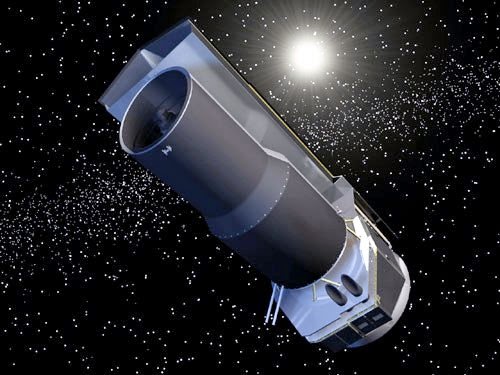
An artist's impression of NASA's
Spitzer Space Telescope in orbit
(Credit: IPAC)
A further complication for mid-infrared telescopes is that the telescopes themselves have to be cooled to very low temperatures to prevent them from radiating infrared photons themselves! This is because, even in space objects will radiate infrared radiation depending on their temperature. These photons would contaminate the measurements made, and so the entire telescope has to be cooled to incredibly low temperatures, much lower than anything in our solar system, to prevent them from radiating significantly large amounts of infrared radiation. Both space telescopes used cryostats filled with liquid hydrogen to achieve this, allowing them to be cooled to less than -263 C (under 10 K).

That brings our list of the largest astronomical catalogs to a close, for the time being at least. Astronomy is moving ever so rapidly towards bigger and bigger catalogs and it is almost certain that these catalogs will be eclipsed in the near future. The most likely candidates to take the throne of largest astronomical catalog will probably come from either ESA's Gaia satellite or the Large Synoptic Survey Telescope (LSST). More on these in a future post!