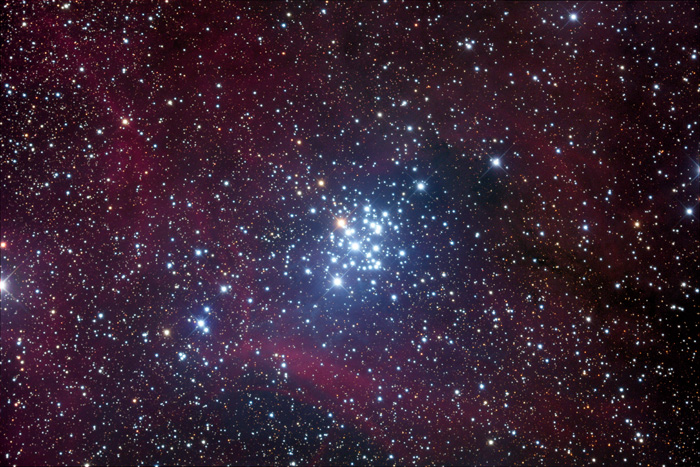
Showing posts with label massive stars. Show all posts

Thursday, 26 May 2016

The perils of star formation in the vicinity of massive stars

Some collaborators and I have recently had an interesting paper published in which we show that stars born in the vicinity of massive OB stars may be less likely to form planetary systems that stars born further away from such stars.

In our Galaxy stars form in a wide variety of environments, from small regions with only a handful of stars, up to massive star clusters and associations with millions of members. The larger regions are also home to tens to thousands of massive OB stars that emit immense amounts of energetic radiation that can affect nearby stars.

The OB association Cygnus OB2 (Credit: CXO).
One of the questions facing astronomers is whether stars born in the vicinity of multiple OB stars might grow up differently to stars born in regions devoid of such objects. In particular it has been suggested that the radiation from these massive OB stars could erode the disks of material that surround young stars.  These protoplanetary disks are thought to be in the process of forming planetary systems just like our Solar System, so its important we understand how they form and evolve.

The study, lead by my colleague Mario Guarcello, focusses on young stars in the OB association Cygnus OB2, a region home to thousands of massive and luminous OB stars, as well as many less massive stars like our Sun. In the paper they study the spatial distribution of stars with and without protoplanetary disks and find that stars nearer to OB stars are less likely to have a disk around them than stars further away from the OB stars (see figure to the right).

The fraction of stars with disks (y-axis) plotted
against the strength of ultraviolet radiation
from massive stars (x-axis). The fraction of stars
with disks is lower when the ultraviolet flux is
higher (Credit: Guarcello et al. 2016).
This suggests that the OB stars are somehow eroding or destroying the protoplanetary disks around stars in their vicinity, most likely due to the photo-evaporation of material in the disks by the harsh ultraviolet radiation that these stars emit.

This result is very important for our understanding of where planetary systems are forming in our galaxy and what factors are hindering this process. As we start to search for planetary systems in distant star clusters we may find that such systems are rarer, or perhaps have fewer planets in them, than those around stars that aren't in star clusters.

This may also tell us something about where our Sun and its Solar System formed. If protoplanetary disks are eroded in massive clusters and associations, then it is unlikely that our Sun formed in an environment such as this.

Tuesday, 5 April 2016

How do you form a massive black hole binary? (Part 3)

This post brings to an end a three-part series of posts about how massive black hole binary systems form, such as those recently observed to merge by the LIGO gravitational wave detector. The first two posts discussed how such massive black holes could form and how a binary system of black holes could form in isolation. Here I'm going to talk about a much more efficient way to form binary black holes, and that's in a star cluster!

As we discussed last week, forming a binary black hole in isolation is very hard. There are lots of processes that could disrupt the binary system before both stars form black holes, and once the binary has fallen apart it's hard to put it back together. But not so in star clusters! In star clusters there are lots of (gravitational) interactions between stars (or black holes) that, under the right circumstances, can lead to the formation of new binary systems. In fact there have been many simulations to explore exactly this sort of process!

The dense and massive star cluster R136 in the 30 Doradus nebula. The bright blue dots are predominantly massive
OB-type stars, many of which will end their lives as black holes (Credit: HST).

The basic idea is a simple 3-step process first put forward by Sigurdsson & Hernquist in 1993. The first step is that star clusters are full of massive stars, and these massive stars are heavier than normal stars and so they naturally sink to the centres of the clusters (we observe this process, called mass segregation, in many star clusters). The second step is that once these stars reach the ends of their lives they explode as supernovae and leave behind stellar remnants such as black holes. This we also know to regularly take place.


Simulation showing the development of mass segregation in a star cluster after only 2 Myrs (right)
compared to a lack of mass segregation at the beginning of the simulation (left). The massive stars (big circles)
are clearly more centrally concentrated in the right-hand panel (Credit: Marc Freitag).

The third step, which is where the clustered environment of the star cluster is critical, is that close encounters between stars (or black holes) in the centres of star clusters can quickly lead to the formation of binary systems, and therefore potentially black hole binary systems. Outside of star clusters the density of stars in space is very low and close encounters are very rare (which is fortunate for our Sun and solar system otherwise we'd always be bumping into other stars!). But star clusters are dense and the stars within them are moving very fast, meaning that close encounters between stars are common. If the stars come close enough to each other in just the right way then a binary system forms.

Many studies have confirmed this general picture and have estimated that it should take (on average) about 1 Giga-year (1000 million years) for enough interactions to occur between stars and black holes to form a binary black hole system in a dense cluster. This means that such binary black hole systems are most likely to be found in older clusters, such as globular clusters, though it shouldn't be impossible to find them in younger clusters.

Does the Omega Centauri globular cluster house
a central black hole? (Credit: ESO)
There is good evidence that this happens quite often. A recent study of the massive globular cluster Omega Centauri found that the dynamics of its stars suggest a particularly massive central black hole, while another study even found evidence that there might be a black hole within the nearby Orion Nebula Cluster. Confirming these theories is difficult because directly detecting black holes isn't always easy, but the evidence is there to suggest they might be occupying many of our favourite star clusters!

Further dynamical interactions within the star cluster can lead to two important effects for the binary black hole system. The first is that the binary will shrink over time due to dynamical interactions with individual stars - this brings the black holes in the binary closer together, making an eventual merger more likely. The second effect is that these black hole binary systems can be easily ejected from the star cluster, often at quite high velocities, through interactions with other binary systems.

The most likely clusters to produce binary black hole mergers are intermediate age clusters with ages of a few Giga-years. Younger clusters are unlikely to have had enough time to form the binary black hole systems, while older clusters will have formed them but they might have all merged by now.

This process implies that a typical star cluster, which contains many massive stars, will easily produce many black holes, and most likely a few black hole binary systems that will one day merge and release gravitation waves just like those observed in September.

Given how many star clusters there are in the Universe its hardly surprisingly that such a black hole merger was observed so easily!

Thursday, 24 March 2016

How do you form a massive black hole binary? (Part 2)

Following the recent discovery of gravitational waves from a merging black hole binary system, I've been dedicating a few posts to exploring how such a system could have formed in the first place. Last time I talked about how such massive black holes could form, and here I want to discuss how a binary black hole system could form.

Artist's impression of a binary system comprised of
two massive OB stars (Credit: Universe Today)
The answer to this question depends a lot on where the black holes formed. It's a lot easier to form a binary black hole system in a star cluster where there might be many black holes than it would be to form such a system in relative isolation.

Lets deal with the more difficult case of forming a binary black hole system in isolation first. Most massive stars (the precursors of black holes) are actually born in (and spend most of their lives in) binary systems composed of two massive stars orbiting each other. However, there are many events during a massive star's life that can disrupt the binary.

Schematic of a binary star system undergoing
common-envelope evolution
(Credit: Adrian Potter)

First, the star swells up and inflates to become a red supergiant. These are the largest types of star known, with diameters hundreds of times their original size and many thousands of times larger than our own Sun. If the red supergiant is in a binary system then it is possible that its outer atmosphere could spill over onto the secondary star, forming an envelope of material that encompasses both stars.

This process is known as common-envelope evolution, so-called because the two stars effectively share their outer envelopes (see the figure to the right). The stars in the common envelope experience a drag on their binary orbits, slowing them down and shrinking the binary system. The phase is typically quite short-lived, but can actually end with the two stars merging!

If the binary system survives the common-envelope phase it may be disrupted by the material the star has ejected during this phase. Red supergiants expel a considerable fraction of their mass through stellar winds. This weakens the binary system by taking away some of the mass holding it together, which causes the binary system to widen. If the system widens sufficiently the stars may actually separate and the binary will be no more!

Finally, the last act in the life of a massive star is a supernova explosion. Again, this expels considerable mass from the star and therefore from the binary system, which could disrupt the binary. In fact this is a commonly-considered mechanism for the disruption of binary systems composed of two massive stars.

This presents a difficult path for a massive binary system to negotiate if it is to become a black hole binary. The system must survive a potential common-envelope phase while one (or both) stars are red supergiants and it must survive the loss of considerable mass from both stars from stellar winds and supernova explosions that can weaken the binary. However, if the system negotiates these obstacles then it could form a binary black hole system just like that observed to merge by LIGO.

Next time I'll talk about a potentially much simpler way to form a massive black hole binary system, and that's in a star cluster!

Monday, 24 August 2015

Why is there a giant ring of young stars surrounding us?

A few weeks ago I talked about one of the nearest (and most important) regions of star formation, the Taurus Molecular Cloud. This region however isn't alone in being a relatively nearby region of star formation, in fact it forms part of a group of such regions that circles us in the night sky and which is known as the Gould Belt.

The Gould Belt is a ring of nearby star forming regions and young star clusters that surrounds our Sun. It was first observed by John Herschel (son of the famous William Herschel who discovered infrared radiation), who noted it as a band of bright stars that circled the sky, tilted away from the plane of the Milky Way, which also circles the night sky.

The bright stars of the Scorpius-Centaurus OB association,
part of the Gould Belt of young stars and star forming regions
(Credit: Akira Fujii)
The belt was named after an American astronomer called Benjamin Gould who performed the first detailed study of the structure in the 1870s. Gould was a pioneering and prominent astronomer, the first American to earn a doctorate in astronomy, and would go on to found the Astronomical Journal, one of the most prominent astrophysical journals in the world.

In the early 20th century astronomers were able to use spectroscopy to measure the speeds of the stars in the belt and found that they were moving with similar motions. This meant that all the stars in the Gould Belt were part of a single coherent structure. The distinctive pattern of the stellar motions has also revealed that the belt is both expanding and rotating. The rotation of the belt is thought to be caused by the fact that it sits embedded within the Milky Way galaxy, which is itself rotating as well.

The system appears to be broadly flat and pancake-shaped, approximately 2000-3000 light years across, but only about 400-500 light years thick. There is also evidence that the belt isn't perfectly circular and is more oval-shaped, a distortion that is also thought to be due to the rotation of the Milky Way as it stretches and twists the belt.

Illustration of the Gould Belt across the night sky relative to the distribution of molecular clouds in our galaxy. The Gould Belt is shown in red and the Galactic Plane is shown in blue. (Credit: Nick Wright / Thomas Dame)

The discovery of molecular clouds of hydrogen gas in the second half of the 20th century revealed that the Gould Belt was made up of many such clouds. When it was later realised that such clouds were where stars form it was quickly recognised that the Gould Belt represented a major site of star formation. It is now known that these star-forming molecular clouds make up most of the mass of the Gould Belt. This includes many well known structures such as the Taurus Molecular Cloud, the Orion Nebula, and the Rho Ophiuchi cloud complex.

While there are still many stars forming in the Gould Belt there is also a considerable history of star formation dating back almost 60 million years. This has lead to a huge collection of young star clusters (such as the Pleiades and Alpha Persei clusters), many OB associations (the famous Scorpius-Centuaurus association amongst others), and a number of luminous supergiant stars (such as Antares, the bright red star in the constellation of Scorpius). Supergiants are massive stars that are coming to the ends of their short lives and these objects were most likely born in one of the star forming regions in the Gould Belt. In fact the Gould Belt includes the majority of massive stars in the solar neighbourhood.

The young star clusters and OB associations that make up the Gould Belt,
shown in 3D relative to the plane of the Milky Way.
(Credit: New Scientist)

Since the discovery of the Gould Belt astronomers have been trying to understand how such a large and coherent structure formed within our galaxy. It was first thought that it formed when a massive star exploded as a supernova. The shock wave from the supernova would have swept up huge clouds of gas, compressing them and triggering the formation of new stars within them. However, if this were the case the ring should be aligned with the Galactic Plane and not pointing out of the plane (as the above image shows), so this theory appears to be ruled out.

A recent suggestion is that the Gould Belt was produced when a massive cloud of gas collided with our galaxy, in the same way that dwarf galaxies are known to collide with our Milky Way galaxy. This collision would have lead to a giant ring of expanding gas in the Milky Way that would be inclined at the same angle to the Milky Way of the collision itself. The shock wave from this would lead to the triggering of star formation and the creation of young star clusters, just as in the structure we see today.

This theory represents the best explanation astronomers have for the Gould Belt at this present time. Recently weight was added to this theory when astronomers found evidence for similar structures to the Gould Belt in other galaxies, suggesting that this phenomena may not be that rare.

The Gould Belt is just one of many structures in our galaxy that we can observe, from local star-forming clouds up to massive spiral arms. Understanding how these structures relate to the continual process of star birth and death and the evolution of our galaxy is one of the major tasks for astronomers today. Next time you look up at the night sky and see the bright stars and star clusters that are part of the Gould Belt think of how these objects are a part of the continual evolution of our galaxy!

Sunday, 29 March 2015

The massive stars of Cygnus OB2

A couple of weeks ago I talked about an OB association known as Cygnus OB2, one of the largest groups of young stars in our galaxy, and an exciting location to study star formation on the grandest scales. This week I want to tell you about some research I recently carried out to better understand this region, research which has recently been published.

The Cygnus OB2 association, as seen though a combination of
X-ray (blue), optical (yellow) and infrared (red) light
(Credit: Chandra X-ray Observatory)
There has been a lot of work carried out recently by many other astronomers to understand some of the really massive stars in Cygnus OB2, which are all very interesting objects, many of which are unique and can tell us exciting things about how massive stars live their short and turbulent lives. Thanks to this work we're now in a position to put all this information together and use it to better understand the entire group of stars as a whole, and that's what I did!

I was able to gather information about 169 massive stars in Cygnus OB2, including some stars as massive as 100 times the mass of our Sun. For each of these stars I was able to determine their mass and age, by comparing their measured properties with the predictions from models of how massive stars evolve throughout their lives. One of the main advances in astronomy over the last few decades has been the development of models that describe not just how stars change throughout their lives, but how they appear during this time. These models, known as stellar evolution models, allow astronomers to estimate how old and how massive the stars that they see are.

The positions of massive stars (red, green and yellow dots) across the Cygnus region, shown against a black and white infrared image of the region. The white circle denotes the area covered by Cygnus OB2 and studied in my paper
(Credit: Nick Wright)

With this information we were able to determine the approximate ages of all the massive stars, allowing us to determine what's known as the star formation history of the region. The star formation history tells us when all the stars formed, and that's important to know if we want to understand how massive OB associations like this formed.

The simple view would be that all the stars formed at the same, or at least very similar, times. This is what's known as instantaneous star formation, or star-burst, because all the star formation occurs in a quick burst when the conditions in the molecular cloud become right for star formation.

The centre of the Cygnus OB2 association - or is it multiple associations?
(Credit: Nick Wright)
However that wasn't what we found. Instead we found that the ages of the stars were spread out over quite a long time period, almost 10 million years. That's a long period of time for star formation, because most astronomers think star formation occurs quickly, within only 1-2 million years or less. But here we're seeing that the star formation didn't happen all at once but was spread out, happening almost constantly for 10 million years.

What does this mean? Is the star formation that has occurred here any different from star formation taking place elsewhere? Probably not. What probably happened here is that the star formation didn't just take place over a long period of time, but probably also took place over a large area of space, almost like multiple small star formation events! These individual star formation events have since merged and combined so that we see them now as this large and homogeneous group of young stars.

It's a theory anyway. One of the great joys of science is discovering something you didn't expect to find, thinking of a new theory to describe what you saw, and then testing your theory. Science is not set in stone but is continually evolving with new theories being proposed, and existing theories being tested, and then refined or discarded. We call this the scientific method, and it underpins all of science.

You can read the full paper here if you're interested to learn more.

Sunday, 1 February 2015

Where stars form

Yesterday we were treated to a stunning image on the Astronomy Picture of the Day website, which showed off one of the regions in our galaxy where stars are in the process of forming. The image is shown below in infrared light, using data from NASA's Spitzer Space Telescope.

The W33 star forming region as seen in infrared light (Credit: NASA / Spitzer Space Telescope)

This region is called W33, so called because it was the 33rd object catalogued by Gart Westerhout in his survey of radio sources in our Galaxy. Many of the sources catalogued by Westerhout are regions in which stars are forming, such as this one.

Astronomers refer to these regions as massive star forming regions, not just because they are massive (this image is about 100 light years wide!), but also because they are the sites where massive stars are forming. Massive stars are the hottest and most luminous stars that exist, and they play an important role in how a galaxy evolves thanks to their luminosity, the strong winds that emanate from their surfaces, and the supernova explosions in which they end their lives.

For these reasons, and because of their short lives and inherent rarity, massive stars are important objects to study. Furthermore astronomers aren't entirely sure how they form, so regions such as this where massive stars are known to be forming, are important to study.

Friday, 3 October 2014

Searching for stars that run away

So it's observing proposal season and Wednesday was the ESO deadline, which means panicked proposal writing and last-minute scribbling all round.

ESO is the European Southern Observatory, Europe's premier observatory in the southern hemisphere, which operates some of the largest and most advanced telescopes in the world. This includes the four behemoths that make up the VLT, the Very Large Telescope (except there's four of them), each housing a 8.2m mirror and some of the best astronomical instruments in the world.

ESO's Very Large Telescope(s) in Chile (Credit: Wikimedia Commons)

One of the proposals we submitted is part of work by my colleague Mike Mohr-Smith to improve the census of massive stars in our galaxy and identify where they formed. Massive stars are very rare and live very short lives (on astronomical timescales at least), but affect the evolution of other stars and the galaxy as a whole in very important ways. How massive stars form is a major unanswered question in astronomy, and since they live such short lives finding these stars and tracing them back to their birth-sites is an important avenue of research.

So we've recently identified a number of hitherto-undiscovered massive stars in the vicinity of one of the young massive star clusters in our galaxy, Westerlund 2. The most massive stars we know of are nearly always found deep within star clusters, and some people have suggested that they can only form in such environments, so finding massive stars near a massive star cluster, but not within it, is very interesting.

The massive star cluster Westerlund 2 (Credit: Robert Gendler)

So the question arises, did these stars form outside of the cluster (which would make them very special) or did they form in the cluster but have since been ejected? The first step in answering this question is to measure the speed these stars are moving relative to the cluster. If the stars have been ejected (known as runaway stars) they should be moving very fast away from the cluster, but if they formed in isolation their velocities will be much lower.

By taking high resolution spectroscopy of these stars we can measure their speeds by observing the shifts in the positions of known spectral lines due to the Doppler effect. This is the same effect that causes the pitch of a siren to change as a vehicle moves towards you and then away from you, but instead of affecting sound waves it is shifting light waves.

Representation of the Doppler-shift effect on spectral lines
(Credit: University of Virginia)
This image shows a spectrum of light, which is light split into its constituent parts using a prism. What was originally white light has now been split into all the colours of the rainbow (it's actually the same effect that causes a rainbow!).

On top of the rainbow you can see dark lines, which are known as spectral lines. These are caused by atoms of different elements absorbing light at certain wavelengths (in certain parts of the spectrum). When an object is moving away from us, it's light is redshifted, meaning spectral lines shift towards the red part of the spectrum, while when an object is moving towards us it's light is blueshifted, meaning spectral lines shift towards the blue part of the spectrum. The faster an object is moving relative to us, the greater the shift in the position of the spectral lines. So by observing the spectrum of light from a star, measuring the positions of it's spectral lines and comparing them to the positions we know they should be at we can determine how fast the star is moving towards or away from us.

So our objective is to use one of the instruments on the VLT to acquire high-resolution spectroscopy, measure the positions of the spectral lines and therefore the speed the stars are moving relative to the stars in the cluster. With this information we can answer the question of whether these very massive stars formed inside the cluster or outside of the cluster.

That's our plan at least, and that's what we've written to the friendly people at ESO asking them if we can use their telescope to do this project. I'll let you know what they say!