Showing posts with label globular cluster. Show all posts

Friday, 24 March 2017

What's wrong with globular clusters?

Globular clusters are amongst the oldest and most massive star clusters in the Universe. Their size and luminosity means that not only can we study the approximately 150 globular clusters in our own galaxy (the Milky Way) in quite a lot of detail, but we can also observe and study globular clusters in other galaxies. This is useful because globular clusters, like all types of star cluster, can provide unique insights into how galaxies form.

For many years astronomers have considered globular clusters to be examples of simple stellar populations, meaning that all the stars in them are thought to have formed at the same time and out of the same gas cloud, meaning that their initial chemical compositions were thought to be very similar. However, recent observations have shown that many globular clusters show evidence for multiple stellar populations with different chemical compositions (e.g., Gratton et al. 2012).
Colour magnitude diagram for the globular cluster NGC 2808.
Each dot represents a star in the cluster. The distribution of
dots into multiple but distinct lines suggests the presence of
multiple populations (Credit: Piotto et al. 2007).

How do astronomers know that there are multiple populations in these globular clusters? Well, if you measure the colour and brightness of all the stars in a cluster and plot their distribution then a single population of stars will form a single distribution in a narrow line, but astronomers have found that globular clusters appear to show multiple distributions.

The image on the right shows one of these plots, referred to as a colour-magnitude diagram (the magnitude of a star is a measure of its brightness), for the globular cluster NGC 2808. The stars are distributed in a narrow band, but closer inspection shows that this band is actually made up of multiple, narrower bands.

This means that the globular cluster is made up of multiple populations of stars, each with a distinct chemical signature that is different from the other populations. Astronomers can measure the chemical compositions in the different populations using spectroscopy, confirming that these discreet bands in the colour-magnitude diagram are caused by different chemical abundances.

The origin of these multiple populations aren't currently known. There are various possibilities that are being considered by astronomers, mostly involving multiple bursts of star formation within the clusters (e.g., D'Ercole et al. 2008), with the second generation of stars being chemically enriched by some process.

This then leads to the question of what could cause the chemical enrichment. There are various ideas that are being investigated, ranging from material being ejected by evolved stars, thrown off by rapidly-rotating stars, or even violent ejections by interacting massive binary stars. Astronomers are currently trying to work out which of these effects are responsible, though its a difficult task because most of this enrichment would have occurred many billions of years ago!

Understanding these massive star clusters is important because they represent some of the oldest star clusters that we can study and their formation appears to be closely related to the formation of their host galaxy.

Tuesday, 16 February 2016

Why are we interested in star clusters?

This blog is all about star clusters, which are pretty stunning and amazing astronomical objects, but some of you might be wondering why astronomers are so interested in them. So in this post I thought I'd give my Top 5 Reasons to Study Star Clusters! I hope you enjoy it!

The Orion Nebula Cluster, seen in X-rays and
optical light. By estimating the masses of the
young stars formed here we can study the
distribution of stellar masses that form
(Credit: Chandra X-ray Observatory)
1. Star formation. Perhaps the most important reason to study star clusters is because we believe the majority of stars form in groups or clusters and so by studying young star clusters we hope to learn something about how stars form. For example, by measuring the masses of all the stars in a cluster we can study the mass distribution of recently-formed stars (known as the initial mass function), which is one of the most important products of the star formation process.
Hubble Space Telescope image of an evaporating
protoplanetary disk (known as a proplydin the
Orion Nebula. The disk (dark silhouette in the
centre) is being eroded by radiation from a
nearby bright O-type star leading to the tail of
material stripped off(Credit: NASA/HST)

2. The impact of environment on star formation. Stars form in many different environments, from small groups of only a handful of stars, up to dense clusters with millions of stars and many thousands of luminous and massive OB stars. In dense clusters young stars are very close to each other, which can lead to close encounters that might disrupt binary systems or planetary systems. The bright OB stars that are present in the most massive clusters can also erode the disks around stars in which planets form, potentially hindering the creation of a full solar system like our own. Understanding how the environment that stars form in affects their final properties is therefore very important!

3. Stellar evolution. Just like humans, stars change as they age in many different ways, from subtle changes in their luminosity and slowing their rotation, to dramatic changes as they switch their source of nuclear fuel. To study these changes we need to know how old the stars are, but unfortunately its very difficult to measure how old individual stars are (we can't ask stars how old they are like we do with humans!). If you have a group of stars, however, you can often work out how old the group is by studying which stars have come to the ends of their lives and which haven't. This allows you to estimate the age of the cluster, and therefore all the stars in it. Once you know their ages you can study how the stars have evolved over time, an area of research known as stellar evolution.

The life cycle of a star like our Sun (upper row) and a more massive OB-type star (lower row).
Both types of star form in star forming regions and star clusters, but evolve through different
phases. By studying this process in star clusters with known ages, astronomers can
calculate how long this evolution takes (Image credit: SciOly.org)

4. Star clusters can be used to study star formation in distant galaxies. Its easy to study star formation in our own galaxy, the Milky Way, because we can observe stars forming deep within molecular clouds and the young stars that have recently formed. But in distant galaxies these things are too small and too faint to observe, so our understanding of star formation in other galaxies, whether it is different in any way, and how much star formation has been occurring, is limited. Star clusters however are bright and we can easily observe them in distant galaxies. Its also relatively simple to get a good estimate of their mass, the type of stars in them, and how old they are. This is really useful for astronomers because it means we can study not just the current star formation in these galaxies, but also star formation that occurred in the past. Astronomers call this the star formation history of a galaxy and its useful for understanding how galaxies evolve over cosmic time.

The Antennae Galaxies, two interacting galaxies with a rich and vibrant star formation history.
Astronomers have been able to study its star formation history by observing the many
star clusters (bright blue dots surrounded by red clouds) (Credit: Hubble Space Telescope)

The Jewel box Cluster (NGC 4755), one of many
clusters that are important for measuring distances
in astronomy! (Credit: APOD)
5. Star clusters are an important step on the cosmic distance ladder. In actual fact, they're two steps! The first step is a 'local' step on the cosmic distance ladder, and it comes from a process known as the moving cluster method, which is essentially a perspective effect whereby if you know the direction that all the stars in a cluster are moving you can estimate how far away it is. The second step is a much more 'distant' step on the ladder, which uses the luminosity of globular clusters to estimate the distance of the galaxy that they're in. The method stems from the assumption that the brightness globular cluster in a galaxy usually has the same luminosity as the brightest globular cluster in another galaxy. Based on this, if you can measure how bright the globular clusters in a galaxy are, you can estimate how far away the galaxy is.

There are many other reasons to study star clusters, but these are some of the most important and wide-ranging, spanning the formation of planetary systems to the size of the Universe!

So next time you hear about star clusters or new research into our understanding of these amazing objects, think about all the different scientific topics that might be influenced by those new results!

Monday, 22 December 2014

Globular Clusters: the grandaddies of all clusters

This week I heard a fascinating talk about globular clusters, so I wanted to take this opportunity to tell you about globular clusters, and some of the science being done to study and better understand these amazing astronomical objects.

Globular clusters are a type of star cluster, but they're a very special type of star cluster, partly because they're very massive, but also because they're very old, almost as old as the Universe itself. For this reason they provide a glimpse of how stars, and star clusters, formed a long time ago.


The Omega Centauri globular cluster, the largest in
our galaxy (Credit: ESO)
Globular clusters are huge and contain millions of stars, considerably more than other types of star cluster. Although there are no fixed boundaries for the size of a globular cluster, they typically contain between 100 thousand and a few million stars, though there are some even larger than this.

The largest globular cluster in our galaxy is Omega Centauri, which is thought to contain approximately 10 million stars. Though it is quite distant it is relatively bright and can be seen with a pair of binoculars, as can many of the other globular clusters in our galaxy.

In addition to being massive, globular clusters are also very old. The ages of globular clusters can be determined by studying how the stars in the cluster have evolved based on our understanding of stellar evolution (the study of how stars evolve). The globular clusters in our galaxy seem to be about 11-13 Gyr old (1 Gyr = 1000 million years). This is just younger than the approximate age of the Universe, 13.7 Gyr, suggesting globular clusters were some of the first objects to form in the Universe.

The M80 'Scorpio' globular cluster (Credit: Baran Observatory)

It is thanks to their old age that globular clusters are so round and spherical. Globular clusters are held together by the mutual gravitational attraction of all the stars in the cluster, and over time this gravitational attraction has smoothed out any small structural differences in the cluster and created an almost perfect ball of stars. In fact globular clusters are really useful for studying how gravity affects clusters of stars, simply because they've been around for so long and have been relatively undisturbed by the galaxy.

The reason globular clusters haven't been disturbed by the galaxy they reside within is because of where within the galaxy globular clusters are found. The oldest stars in our galaxy are found not in the disk of the Milky Way galaxy, but in its halo, which is a spherical and diffuse cloud of stars within which the disk of our galaxy sits. Globular clusters are as old as the oldest stars in our galaxy and are found distributed across the Galactic halo in relative isolation compared to the spiral-shaped disk of the galaxy.

The structure of our galaxy, showing the globular clusters in the Galactic halo (Credit: University of Oregon)

Our galaxy contains approximately 150 known globular clusters, with experts suggesting that there may be 10 to 20 still to be discovered. Because of their brightness we can identify globular clusters in other galaxies and some large galaxies have many more globular clusters than the Milky Way, for example the Andromeda Galaxy may have as many as 500 globular clusters!

One of the great mysteries of globular clusters is how they formed, whether they formed in a single burst of star formation or whether they are made up of multiple generations of stars. This also raises the question of whether globular clusters are significantly different from some of the smallest type of galaxy we know of, for example the dwarf spheroidal galaxies. All of these unanswered questions are very important for understanding how stars and galaxies form, which makes globular clusters an important area of astronomical research.

Thursday, 25 September 2014

What are star clusters?

What are star clusters? Star clusters are large groups of stars held together by some force, usually the gravitational attraction of all the stars in the cluster.

You may be familiar with two types of star cluster that can be readily observed with the naked eye or a pair of binoculars: open clusters and globular clusters, though there are also other types of cluster such as embedded clusters, young massive clusters, and even slight variants such as OB associations and T associations.

Open clusters may be the most well-known type of cluster because this category includes famous naked-eye examples such as the Pleiades and Hyades clusters. Open clusters are small groups of stars, commonly from a few hundred to a few tens of thousands of members (though there is no fixed upper or lower limit), with ages anywhere from a few tens of Myr (mega-year or 1 million years) up to billions of years (or Gyrs). Open clusters are common in our galaxy, with over a thousand already known, and many are close enough for us to study in detail.

The Pleiades open cluster (Credit: Alson Wong)

Globular clusters on the other hand are very different to open clusters. For a start they are much more massive (in mass as well as in size), containing anything from hundreds of thousands to millions of stars, and appearing considerably more rounder or 'globular' than open clusters. Globular clusters are also much older than open clusters, with typical ages of 12-13 Gyr, similar to age of our galaxy. Furthermore, while open clusters are typically found in the disk of our galaxy (where the majority of current star formation takes place), globular clusters are found in the halo of our galaxy (where star formation might have primarily taken place when our galaxy first formed).

There are about 150 known globular clusters in our galaxy and many more have been found in other galaxies. Some globular clusters are bright and close enough to observe with a pair of binoculars, such as Omega Centauri, the largest known globular cluster in our galaxy.

The Omega Centauri globular cluster (Credit: University of Manchester)

Both open and globular clusters are considered by astronomers to be 'long lived', that is they are thought to be gravitationally stable on long time scales. Clearly globular clusters must be stable for billions of years because they have ages of 12-13 Gyr, though for open clusters the current picture isn't entirely clear. Open clusters have ages up to billions of years, but the majority appear to be quite young with ages of tens or hundreds of Myr, perhaps suggesting that there is a process that disrupts open clusters as they age (I'll come back to this in a future post).

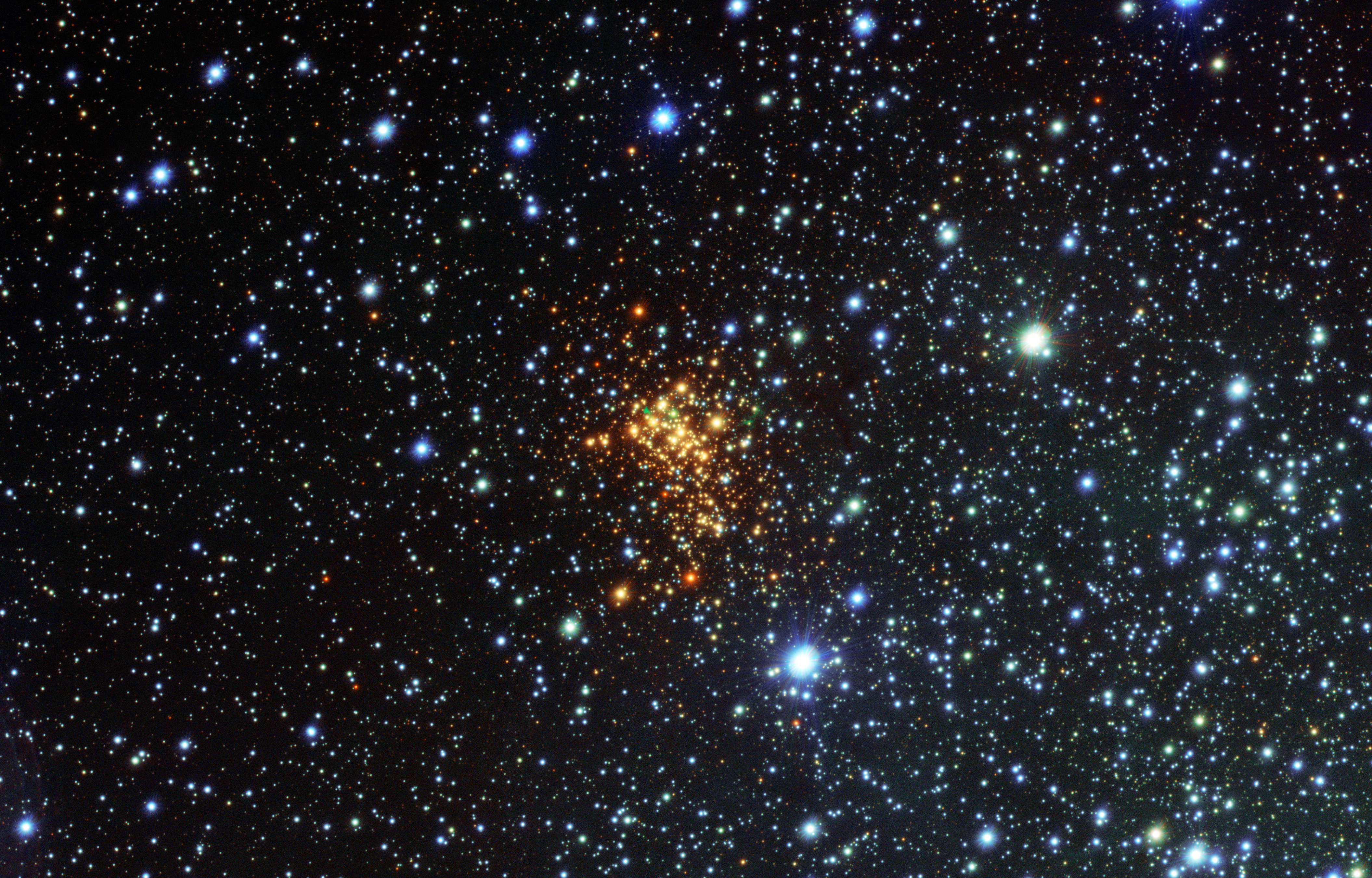
There are also varieties of star cluster that are much younger than typical or open or globular clusters. These are usually divided into two categories: embedded clusters and young massive clusters. The latter appear very similar to the most massive open clusters (containing thousands to tens of thousands of stars) although they are much younger, typically only a few to ten million years old, and therefore contain many massive, but short-lived, stars that are not seen in the older open and globular clusters. The image below shows Westerlund 1, one of the most massive young clusters in our galaxy.

The Westerlund 1 young massive cluster (Credit: Wikimedia commons)

And finally we come to embedded clusters. Like young massive clusters these are also young, with typical ages of up to a few Myrs. Because they are so young these clusters are still embedded within (or on the edge of) the molecular cloud that the stars formed from (I'll discuss how stars form out of clouds of molecular gas in a future post). This leads to an important difference between embedded clusters and other varieties of star cluster. Because the cluster is embedded within a cloud of gas, this gas adds mass to the cluster that can help keep the cluster gravitationally bound (perhaps to the point that the cluster might not be gravitationally bound if it were not embedded within the cloud).

Because embedded clusters are found within molecular clouds, and because the light from all the stars can illuminate and ionise the cloud of gas in the cloud, we often find embedded clusters within some of the famous nebulae in the sky that were discovered in the 17th and 18th centuries.

For example one of the most famous nebulae is the Orion Nebula, which can be seen with the naked eye in the constellation of Orion (surprise!). At the centre of the nebula and illuminating the gas for all to see is a relatively massive cluster of young stars known as the Orion Nebula Cluster. Because of its size and proximity the Orion Nebula Cluster has been very well studied and is one of the most important embedded clusters in all of astronomy.

The Orion Nebula Cluster (Credit: NASA)

Next time you're outside on a clear night, try and find some of these star clusters. You'll need binoculars to see a globular cluster, but open clusters such as the Pleiades or the Hyades are visible to the naked eye, and the even the nebula surrounding the Orion Nebula Cluster can be seen on a clear night!

In a future post I'll discuss the other types of stellar groupings such as OB associations, but for now that covers the main varieties of star cluster.