Showing posts with label 2MASS. Show all posts

Wednesday, 26 November 2014

Surveys, surveys, surveys

I have been in Naples, Italy, this week for a conference about the many wonderful astronomical surveys that have been produced recently. The last decade has been a rich time for survey science, thanks in part to the pioneering surveys at the turn of the century (such as SDSS and 2MASS), but also to the work of new dedicated survey telescopes such as VST and VISTA. These large surveys have provided astronomers with huge samples of stars and galaxies with which to investigate many important aspects of how stars and galaxies form and evolve.

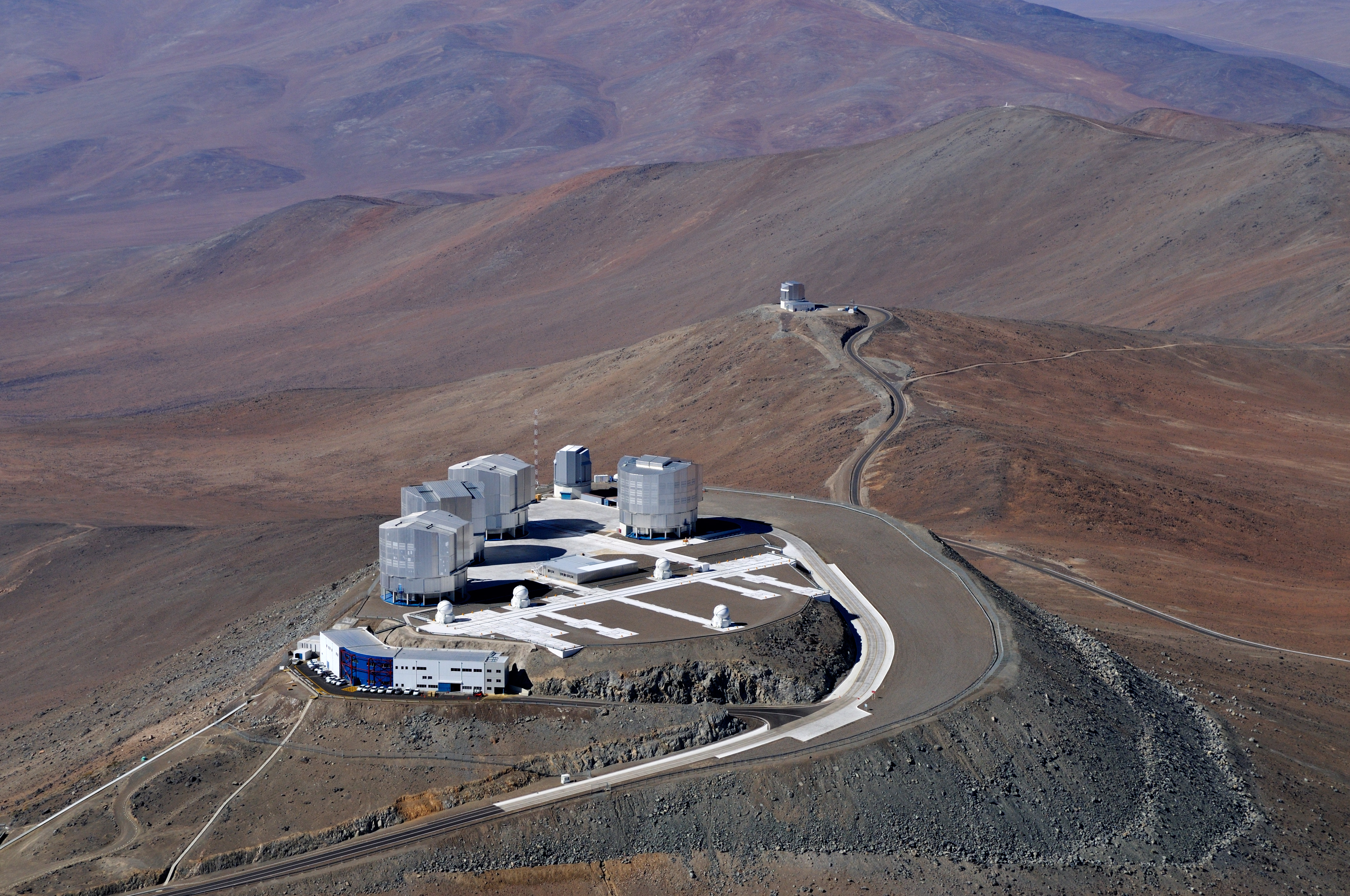
The European Southern Observatory's (ESO) facilities at Cerro Paranal,
including the VLT, VST and VISTA telescopes (Credit: Wikipedia)
It is with one of these telescopes, the VLT Survey Telescope (VST), that I have been using data from over the last few years for the VPHAS+ survey, the VLT Photometric H-Alpha Survey. This is the follow-up survey to IPHAS, the INT Photometric H-Alpha Survey, which I discussed in a previous post.

The VPHAS+ survey was actually the subject of the talk I gave at the conference today. I presented both an outline of the survey and some of the most exciting science results that have come out of the survey in recent years. It was quite an honour to present so much exciting science from across our survey collaboration, and I'm grateful to everyone in the survey who contributed to the work and helped me prepare the presentation. If you want to learn more you can watch my presentation on youTube here (my talk starts at 56:00).

This conference has been a great opportunity to learn both about surveys going on at the moment and some of the surveys planned for the future. As well as the traditional photometric surveys, there are now surveys designed to study how astronomical objects change over time by making repeat observations of the same areas of the sky. Some surveys are already doing excellent work in this area, such as the VVV survey (Vista Variables in the Via Lactae), but there are also some very exciting projects planned for the future, such as the Large Synoptic Survey Telescope (LSST).

Finally, there have been looks to the future of astronomical surveys and particularly the future spectroscopic surveys that will, instead of just measuring the brightness of sources in a few bands, actually take detailed spectra that can be used to determine the physical properties of the sources. The European Southern Observatory, ESO, has plans to convert one of its survey telescopes, VISTA, from being an imaging telescope to being a spectroscopic telescope. This is something that I really look forward to seeing and hopefully using. These are really exciting times for survey astronomy!

Sunday, 19 October 2014

The largest astronomical catalogs ever made! (Part II of II)

In a previous post I introduced the 'Top 10' largest astronomical catalogs that are currently and publicly available for astronomers (and anyone) to download and use. For a quick reminder, here's the list:
  1. The US Naval Observatory (USNO-B1) all-sky catalog, 1046 million entries (2003)
  2. The Guide Star Catalog (GSC v2.3) all-sky catalog, 946 million entries (2006)
  3. The Sloan Digital Sky Survey (SDSS DR9), 933 million entries (2012)
  4. The Wide-field Infrared Survey Explorer (WISE) all-sky catalog, 748 million entries (2013)
  5. The United Kingdom Infrared Deep Sky Survey (UKIDSS), 727 million entries (2012)
  6. The 2 Micron All Sky Survey (2MASS), 471 million entries (2003)
  7. The Deep Near Infrared Survey (DENIS) of the southern sky, 355 million entries (2005)
  8. The INT Photometric H-Alpha Survey (IPHAS), 219 million entries (2014)
  9. The USNO CCD Astrograph Catalog v4 (UCAC4), 114 million entries (2012)
  10. The Galactic Legacy Infrared Mid-Plane Survey (GLIMPSE), 104 million entries (2008)
In that post I discussed five of these surveys (including the IPHAS survey that I work on - read more about that here) that all include astronomical objects observed in the visible part of the electromagnetic spectrum (that is the part that we can see with our own eyes). The other five of these surveys all include measurements made outside of this part of the spectrum, and its those I'd like to talk about today.

The electromagnetic spectrum, with wavelength increasing to the right, and frequency (or energy) increasing to the left. (Credit: NASA)

These five surveys are WISE, UKIDSS, 2MASS, DENIS, and GLIMPSE, and they're all infrared photometric surveys, which means they measure how bright astronomical sources are in the infrared. The infrared part of the electromagnetic spectrum includes radiation with a longer wavelength than that of the light we can see, though not as long as microwave radiation or radio waves. You may be aware that infrared radiation is what we commonly know of as heat or warmth. Any object with a temperature around body temperature or up to a few hundred Celsius will radiate energy in the infrared.

Astronomers often divide up the infrared part of the electromagnetic spectrum into the near-, mid- and far-infrared regions, ordered by how far they are from the visible part of the spectrum. The definition of these three regions isn't important, but originates in the different technologies required to detect radiation in each region (such as different CCD detectors).

The near-infrared is the most easily accessible part of the infrared spectrum, and three of these surveys cover this region. Perhaps the most commonly-used of these is 2MASS, an all-sky near-infrared survey, which operated from 1997 to 2001 at two observatories in Arizona and Chile. The 2MASS all-sky view of the Milky Way is a stunning panorama of our galaxy, aided by the ability of near-IR radiation to penetrate the dust that would otherwise absorb optically visible radiation.

The 2MASS all-sky view of the Milky Way (Credit: IPAC)

The DENIS survey was also a deep near-IR survey that finished in 2001, but which only covered the southern sky. The UKIDSS survey(s) are a series of very deep near-IR surveys (deeper than both 2MASS and DENIS) on the United Kingdom Infra-Red Telescope (UKIRT) in Hawaii that targeted certain areas of the sky for different science goals. Some of these areas include regions of our galaxy where stars are forming and other areas look away from our galaxy out into the darkest regions of space where other galaxies are easily studied.

The remaining two surveys, WISE and GLIMPSE, are mid-infrared surveys, operating at slightly longer wavelengths than the near-IR surveys.

The centre of our Milky Way galaxy seen in the mid-infrared from GLIMPSE (Credit: Spitzer GLIMPSE team)

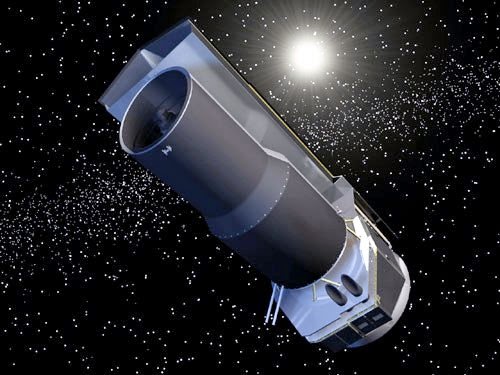
GLIMPSE was a survey of the Milky Way galaxy with NASA's Spitzer Space Telescope, and WISE is also a NASA space telescope that performed an all-sky infrared survey. Because the Earth's atmosphere absorbs most mid-infrared radiation, mid-infrared telescopes have to operate from above the atmosphere.

An artist's impression of NASA's
Spitzer Space Telescope in orbit
(Credit: IPAC)
A further complication for mid-infrared telescopes is that the telescopes themselves have to be cooled to very low temperatures to prevent them from radiating infrared photons themselves! This is because, even in space objects will radiate infrared radiation depending on their temperature. These photons would contaminate the measurements made, and so the entire telescope has to be cooled to incredibly low temperatures, much lower than anything in our solar system, to prevent them from radiating significantly large amounts of infrared radiation. Both space telescopes used cryostats filled with liquid hydrogen to achieve this, allowing them to be cooled to less than -263 C (under 10 K).

That brings our list of the largest astronomical catalogs to a close, for the time being at least. Astronomy is moving ever so rapidly towards bigger and bigger catalogs and it is almost certain that these catalogs will be eclipsed in the near future. The most likely candidates to take the throne of largest astronomical catalog will probably come from either ESA's Gaia satellite or the Large Synoptic Survey Telescope (LSST). More on these in a future post!