Showing posts with label Conferences. Show all posts

Wednesday, 17 June 2015

X-rays from stars

Tomorrow I'm going to a small conference at the University of Warwick to talk about X-ray emission from stars and our Sun. It may surprise many of you to learn that our Sun is a relatively bright source of X-rays, and it certainly surprised most astronomers when this was discovered in the 1940s!

Why is this such a surprise? Well, the surface temperature of the Sun is a relatively modest 6000 C, which may seem like a high temperature to you and I, but its certainly not hot enough to emit X-rays, which require temperatures of millions of degrees. And yet when astronomers launched the first rockets above our atmosphere in the 1940s they found that the Sun was a bright X-ray source!

X-ray image of our Sun taken from the Solar Dynamics Observatory
(Credit: NASA/SDO)

As it turns out these X-rays don't actually come from the surface of the Sun but from a region above the surface called the corona. You can see this in the X-ray image above, which shows the corona reaching above the surface of the Sun. The corona is a hot, low density plasma of gas, which reaches temperatures of millions of degrees, making it very bright in X-rays but almost completely invisible in the optical part of the spectrum.

So why is the corona so hot if the surface of the Sun is much cooler? Well this is actually an open question that many astronomers are still trying to answer, and its a question I've tried to answer by studying other stars. Our current best guess is that the corona is heated by the release of magnetic energy generated deep within the Sun in a type of dynamo. Unfortunately we can't see within the Sun to work out how and why this is happening, which is why this is still an unanswered question. Hopefully tomorrow's meeting will shed some light on this topic!

Friday, 29 May 2015

Tycho Brahe's gin

Last year I attended a conference in Copenhagen and while I was there I wanted to visit Tycho Brahe's observatory. For those who don't know, Tycho Brahe is considered to be one of the greatest astronomical observers in history, particularly in the pre-telescope era in which he lived, and he made many notable contributions to astronomy, including reporting on the 1572 supernova that now bears his name.

Hven gin, made on the island that was once home to
Tycho Brahe's observatory.
In 1576 he constructed an observatory called Uraniborg, which was apparently very impressive. It was built on the island of Hven in the Baltic Sea between Sweden and Denmark, and I was interested in visiting the observatory to see what remained. Unfortunately, as I found out,  the observatory doesn't exist any more, which is a great shame. Luckily for me though I was at least able to bring some part of Hven home with me when I found out that the island is now home to a gin distillery, and since my wife enjoys gin I was able to find a bottle in a Copenhagen liquor store and bring her a bottle home. I'm told it's very good, Tycho would have been proud!

Thursday, 2 April 2015

Milky Way Astrophysics from Wide Field Surveys - Part III

The final day of the Wide Field Surveys meeting started by focussing on the later stages of a star's life, including red giant stars (big, bright and red), asymptotic giant branch stars (bigger, brighter, and redder!), planetary nebulae (a type of dying star), and white dwarfs (the final remnant of a dying star).

The focus then shifted to star clusters, which is my area of interest, and in fact this was when I gave my own presentation to the audience, and then finally there were presentations and discussions about future surveys, which can be useful to think about what research might be possible in the future.

All in all its been a very interesting meeting, with a wide array of science topics covered, which has been useful to stay up to date in current research results in different areas. I'm now a little exhausted though, so I'm looking forward to the long weekend to relax!

Tuesday, 31 March 2015

Milky Way Astrophysics from Wide Field Surveys - Part II

The second day of the Wide Field Surveys meeting has covered a wide range of topics, from the formation of stars, the lives of massive stars, to more evolved stars and even dying stars such as supernovae.

One of the most interesting results presented today came from a sub-mm survey of the Serpens star forming region using the James Clerk Maxwell Telescope in Hawaii. Using this data a group of astronomers have been searching the images for outflows coming from young stars, which is thought to be a common occurrence during the star formation process as a by-product of how stars accrete material from their surroundings.

Outflow coming from the Herbig-Haro object HH47
(Credit: HST/NASA)
After studying these outflows the astronomers were able to calculate the amount of energy that the outflows were injecting into the surrounding molecular cloud. They found that the energy injected from the outflows was as high as 70% of the total turbulent energy within the cloud. Turbulence is the name given to the energetic motions within molecular clouds, and which is thought to be responsible for preventing the molecular cloud from collapsing under its own gravity.

This result suggests that one of the most important mechanisms for preventing molecular clouds from collapsing is the outflows produced by the stars that form within them! Because molecular clouds need to collapse to form stars, outflows are actually limiting the amount of further star formation that these molecular clouds can produce. Astronomers call this feedback, the influence of stars that have already formed on the surrounding molecular cloud, and it's exciting to see it happening in this region.

Monday, 30 March 2015

Milky Way Astrophysics from Wide Field Surveys - Part I


The entrance to the Royal Astronomical Society's
headquarters at Burlington House in London
(Credit: Wikimedia Commons)
This week I'm at a conference in London at the headquarters of the Royal Astronomical Society where we're discussing scientific results from recent wide field surveys of the Milky Way. Wide field surveys is just another name for surveys that cover a large area of space, and there are many surveys these days that fit that category, including a few that I work on.

Because these surveys cover such a large area of space they allow many different types of astronomical objects to be studied, from young stars to old stars, individual objects to the entire galaxy. So a conference like this is a great opportunity to stay in touch with a wide array of scientific results.

Today's talks have mostly been given by the leaders of the surveys, who have been telling us about their surveys, how we can get the data from the surveys, and highlighting some of the scientific results. This is a good opportunity to learn about new survey data and to think about how this data might be useful to solve some of the problems I'm trying to address.

The Milky Way - home of many many surveys! (Credit: ESO)

I've been really impressed with the surveys presented today. They've covered (almost) every part of the electromagnetic spectrum, from radio waves through the infrared and up to the optical part of the spectrum, and they've offered up a huge range of possibilities for future work. They also have some amazing names, including such gems as e-MERLIN and UWISH - astronomers really love acronyms!

The highlight of the day for me was probably a presentation about a sub-mm survey called ATLASGAL. The sub-mm part of the electromagnetic spectrum is between the infrared and the microwave parts of the spectrum. One of the advantages of observing in this part of the electromagnetic spectrum is that it is not absorbed by dust and so can be used to study objects across our entire galaxy, even on the far side of our galaxy that would normally be obscured and inaccessible to us.

Part of the Galactic Plane of our galaxy seen by the ATLASGAL survey showing a number of prominent
star forming regions, including Messier 20, The Triffid Nebula (Credit: ESO/ATLASGAL)

The survey data has been used by a team of astronomers to survey the majority of our galaxy in the sub-mm part of the spectrum and identify hundreds of dense clumps of molecular gas where massive stars are forming. Sub-mm emission is one of the most reliable and efficient methods to identify dense star forming regions. It's an exciting project and I'm looking forward to seeing more results from the survey in the future.

Wednesday, 26 November 2014

Surveys, surveys, surveys

I have been in Naples, Italy, this week for a conference about the many wonderful astronomical surveys that have been produced recently. The last decade has been a rich time for survey science, thanks in part to the pioneering surveys at the turn of the century (such as SDSS and 2MASS), but also to the work of new dedicated survey telescopes such as VST and VISTA. These large surveys have provided astronomers with huge samples of stars and galaxies with which to investigate many important aspects of how stars and galaxies form and evolve.

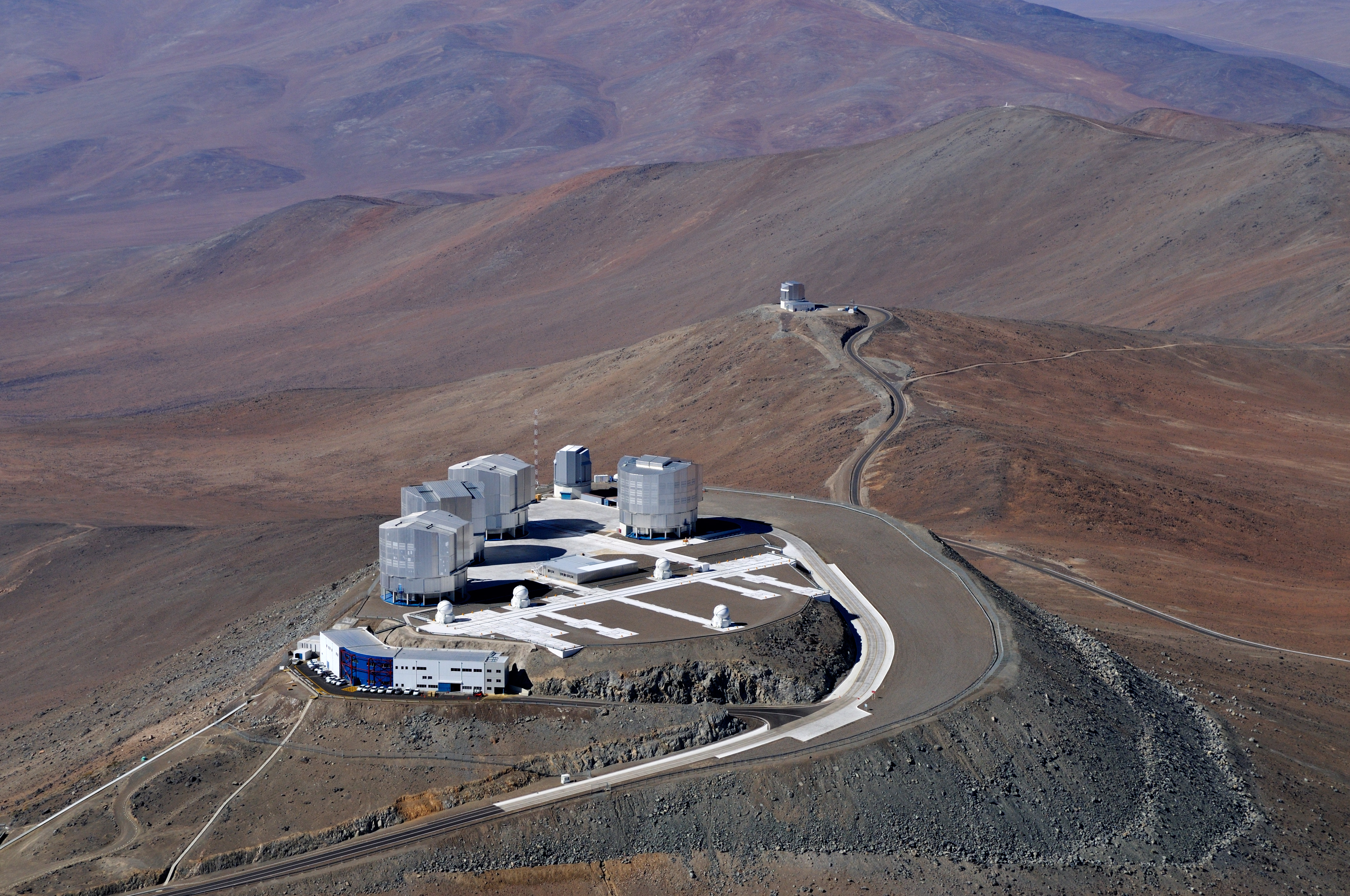
The European Southern Observatory's (ESO) facilities at Cerro Paranal,
including the VLT, VST and VISTA telescopes (Credit: Wikipedia)
It is with one of these telescopes, the VLT Survey Telescope (VST), that I have been using data from over the last few years for the VPHAS+ survey, the VLT Photometric H-Alpha Survey. This is the follow-up survey to IPHAS, the INT Photometric H-Alpha Survey, which I discussed in a previous post.

The VPHAS+ survey was actually the subject of the talk I gave at the conference today. I presented both an outline of the survey and some of the most exciting science results that have come out of the survey in recent years. It was quite an honour to present so much exciting science from across our survey collaboration, and I'm grateful to everyone in the survey who contributed to the work and helped me prepare the presentation. If you want to learn more you can watch my presentation on youTube here (my talk starts at 56:00).

This conference has been a great opportunity to learn both about surveys going on at the moment and some of the surveys planned for the future. As well as the traditional photometric surveys, there are now surveys designed to study how astronomical objects change over time by making repeat observations of the same areas of the sky. Some surveys are already doing excellent work in this area, such as the VVV survey (Vista Variables in the Via Lactae), but there are also some very exciting projects planned for the future, such as the Large Synoptic Survey Telescope (LSST).

Finally, there have been looks to the future of astronomical surveys and particularly the future spectroscopic surveys that will, instead of just measuring the brightness of sources in a few bands, actually take detailed spectra that can be used to determine the physical properties of the sources. The European Southern Observatory, ESO, has plans to convert one of its survey telescopes, VISTA, from being an imaging telescope to being a spectroscopic telescope. This is something that I really look forward to seeing and hopefully using. These are really exciting times for survey astronomy!

Sunday, 9 November 2014

Talking about star clusters in Copenhagen

The absence of posts this week was because I've been taking a break from doing research at my desk and instead I've been at a conference to discuss research with other scientists studying star clusters. The conference was "The Early Life of Stellar Clusters: Formation and Dynamics" and was held in Copenhagen, Denmark, a really beautiful city.

Copenhagen, very pretty (albeit cold)

Conferences are important in science because they allow scientists distributed all over the world to come together and discuss the current state of research with other scientists. This can be particularly important if you work in a small field (such as astrophysics) where the world's experts are spread all around the world. There can be lots of debates and arguments, discussions with collaborators, as well as opportunities to start new collaborations with people you meet.

This meeting attracted about 50 people who all study different aspects of star clusters and who have come together to discuss them. Most of the attendees have given a presentation to the group, including myself (I gave my talk on the first day and was able to relax after that). I talked about my recent work on an OB association called Cygnus OB2 (more on that in a future post) and I think it was well received.

It was a great conference and I'm very grateful to the organisers for putting it together (and for giving me the opportunity to present my work!). The meeting has given me lots of ideas for future projects, has opened the door to future collaborations, and helped develop some existing projects. I'm looking forward to the next conference already!