Showing posts with label VST. Show all posts

Wednesday, 26 November 2014

Surveys, surveys, surveys

I have been in Naples, Italy, this week for a conference about the many wonderful astronomical surveys that have been produced recently. The last decade has been a rich time for survey science, thanks in part to the pioneering surveys at the turn of the century (such as SDSS and 2MASS), but also to the work of new dedicated survey telescopes such as VST and VISTA. These large surveys have provided astronomers with huge samples of stars and galaxies with which to investigate many important aspects of how stars and galaxies form and evolve.

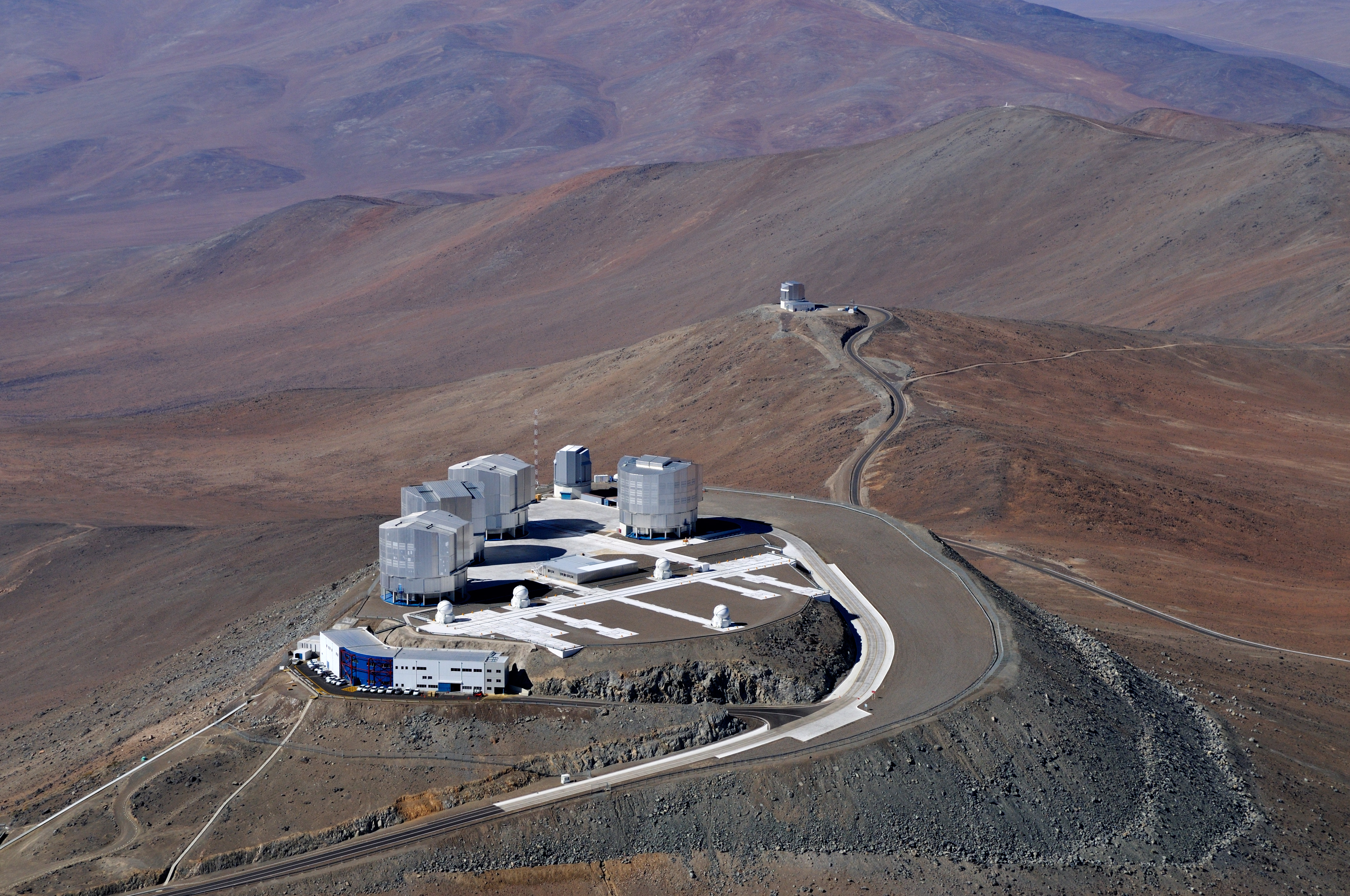
The European Southern Observatory's (ESO) facilities at Cerro Paranal,
including the VLT, VST and VISTA telescopes (Credit: Wikipedia)
It is with one of these telescopes, the VLT Survey Telescope (VST), that I have been using data from over the last few years for the VPHAS+ survey, the VLT Photometric H-Alpha Survey. This is the follow-up survey to IPHAS, the INT Photometric H-Alpha Survey, which I discussed in a previous post.

The VPHAS+ survey was actually the subject of the talk I gave at the conference today. I presented both an outline of the survey and some of the most exciting science results that have come out of the survey in recent years. It was quite an honour to present so much exciting science from across our survey collaboration, and I'm grateful to everyone in the survey who contributed to the work and helped me prepare the presentation. If you want to learn more you can watch my presentation on youTube here (my talk starts at 56:00).

This conference has been a great opportunity to learn both about surveys going on at the moment and some of the surveys planned for the future. As well as the traditional photometric surveys, there are now surveys designed to study how astronomical objects change over time by making repeat observations of the same areas of the sky. Some surveys are already doing excellent work in this area, such as the VVV survey (Vista Variables in the Via Lactae), but there are also some very exciting projects planned for the future, such as the Large Synoptic Survey Telescope (LSST).

Finally, there have been looks to the future of astronomical surveys and particularly the future spectroscopic surveys that will, instead of just measuring the brightness of sources in a few bands, actually take detailed spectra that can be used to determine the physical properties of the sources. The European Southern Observatory, ESO, has plans to convert one of its survey telescopes, VISTA, from being an imaging telescope to being a spectroscopic telescope. This is something that I really look forward to seeing and hopefully using. These are really exciting times for survey astronomy!

Thursday, 30 October 2014

The Lagoon Nebula

This week I've been studying a young star cluster known as NGC 6530, which is embedded within a famous region known as the Lagoon Nebula. This is one of the most famous nebulae in the sky, and a very attractive target for astrophotographers. Below you can see an image of the Lagoon Nebula that I made, and I think you'll agree that the nebula really does look very lagoon-like!

The Lagoon Nebula as imaged by VPHAS+ (Credit: Nick Wright)

The data for this image comes from the VPHAS+ survey (the southern-hemisphere counterpart to the IPHAS survey), which is being run from the European Southern Observatory's VLT Survey Telescope (the VST) in Chile. We compiled this data for ESO last year to help them with a press release, which they used to produce their own image that you can see here. Their image is nice, but I greatly prefer my own because I think we've retained the lagoon-like swirling clouds of gas much better than they have. What do you think?

The NGC 6530 cluster in the centre of the Lagoon Nebula
The Lagoon Nebula is interesting for astronomers like myself because it's a region where stars are actively forming, and you can even see a cluster of stars that have already formed in the centre of the nebula. This cluster, known as NGC 6530 is about 2 million years old (which is quite young for stars!) and contains many thousands of stars, though only the brightest few dozen can be seen in this image.

The nebula can be found in the constellation of Sagittarius, and despite being about 5000 light years from Earth can actually be seen with the naked eye from a very dark sight (though you'd be better off with a pair of binoculars). Unfortunately, even with binoculars the nebula doesn't look as red and purple as these images suggest, but more of a greyish colour. The reason for this is that under low light conditions human eyes are not good at distinguishing colours, and so most faint things appear grey.

The reddish hue of the Lagoon Nebula seen in most astronomical images comes from the fact that most of the light we see comes from a bright emission line known as ('H alpha'), which is a very prominent emission line from the element Hydrogen that can be found in the red part of the electromagnetic spectrum (hence why we astronomers colour these images red to reproduce their real colour).

The 'Hourglass Nebula" in the centre of the Lagoon Nebula
The nebula is illuminated by a number of very massive, young stars that ionise the hydrogen in the nebula and cause it to glow. It is amazing to think that this entire nebula, approximately 100 light years across, can be illuminated by just a handful of bright stars - but these stars are really bright!

There's a lot of small scale structures within the nebula that this image reveals, including a number of prominent dust globules that are silhouetted against the bright nebula. Perhaps the most famous structure within the Lagoon Nebula is the Hourglass Nebula at its heart. This is a very dense and compact ionised nebula where stars are still forming and which is being ionised by a very young and still embedded, massive star. The Hourglass nebula was actually discovered by the astronomer John Herschel, son of William Herschel, so it's quite exciting to be studying a region previously studied by such a famous astronomer!

This is all particularly timely because of a recent paper that presents high-resolution Hubble Space Telescope images of the hourglass nebula (see below). These observations are much higher resolution than our VPHAS+ images and they're much more detailed, but they only cover a small part of the entire Lagoon Nebula. That is one of the great advantages of large-scale surveys such as VPHAS+, they cover everything!

The Hourglass Nebula as seen by the Hubble Space Telescope
(Credit: Maiz Apellaniz et al. 2014)
The detail in this image is really impressive, and the authors of the paper have done some interesting science with it, detecting evidence of the massive star Herschel 36 being a binary system amongst other results. All of this makes the Lagoon Nebula a really interesting scientific target, which makes me feel very lucky to be studying it at the moment!