Showing posts with label distance measurement. Show all posts

Wednesday, 4 November 2015

The distance to the Moon

I've recently been watching the wonderful HBO series From the Earth to the Moon, a dramatisation of NASA's Apollo missions to the Moon, which I'd highly recommend. As I've been watching it I've been reminded of some of the amazing contributions to science that these missions made. Its certainly true that their original motivation wasn't scientific, but that doesn't mean they didn't achieve anything scientifically.

One of their most important achievements is helping to precisely measure the distance to the Moon. Knowing the distance to the Moon and how this changes is important for understanding the orbit of the Moon, which influences tides on Earth, and whether the Moon is spiralling towards or away from the Earth.

Calculations from the ancient Greek astronomer
Aristarchus used to estimate the distance to the Moon
(Credit: Wikipedia)
Prior to the Apollo missions there were various methods to measure the distance to the Moon, including using radar and simple trigonometry. The ancient Greeks were the first to try to measure the distance to the Moon using trigonometry.

The astronomers Aristarchus and Hipparchus both succeeded in using this method, with the latter measuring a distance of about 410,000 km, an estimate which is only off by about 25,000 km, or 7% of the total distance.

To improve the distance measurements that were available at the time, the Apollo programme decided to take special reflectors to the Moon and leave them on the lunar surface. These specially-designed reflectors allow the distance between the Earth and the Moon to be measured by aiming lasers on Earth at the positions of these reflectors and then timing the amount of time it takes for the laser to be reflected back to Earth. Since we know how fast light moves through the vacuum of space we can use the time this journey takes to calculate the distance travelled.

The lunar ranging equipment, as left by Apollo 11 (Credit: NASA)

Once the reflectors were installed by Neil Armstrong and Buzz Aldrin of Apollo 11, a number of telescopes around the world were able to use them to measure the distance to the Moon. Additional reflectors were also left on the lunar surface by the Apollo 14 and 15 missions, with the latter using a particularly large reflector array that was three times the size of the other two reflectors. The majority of distances measurements to the Moon since then have used the Apollo 15 reflector due to its size.

Thanks to the precise measurements that these reflectors have allowed we have learnt a considerable amount about how the distance between the Earth and the Moon is changing. The distance to the Moon, which is approximately 385,000 km, is now known with an accuracy of better than one part in 10 billion. The exact distance changes throughout the Moon's orbit around the Earth, as well as due to a number of smaller effects.

One of those small effects is that the Moon is very slowly moving away from the Earth, at a rate of about 3.8 cm per year. While this is only a tiny fraction of the total distance between the Earth and the Moon it is surprisingly high! Don't worry though, at that rate it would take millions of years for there to be any perceptible change in the Moon's appearance from Earth!
Artist's rendering of the lunar core (Credit: NASA)

Variations in lunar rotation and orbit, measured thanks to these reflectors, have also provided evidence that the Moon probably has a liquid core. This core is thought to be about 20% of the Moon's radius. Seismographic measurements since then have refined this picture, suggesting that the Moon may have a solid inner core surrounded by a fluid and partially-fluid outer core.

Perhaps the most important use of knowing the precise distance to the Moon is the impact of the Moon on the rotation of the Earth, due to tidal gravitational forces. We now know, for example, that the Moon has a small effect on the length of the Earth day, which is changing very slowly due to this effect.

Nick Wirght (2015), The distance to the Moon (Blogger).

Wednesday, 12 August 2015

Tracing the spiral arms of the Milky Way

Our galaxy, the Milky Way, is thought to be a huge spiral galaxy like many such galaxies we see across the Universe. One of the tasks that modern-day astronomers are trying to achieve is to map the size and structure of our galaxy so we can better understand how it formed and how it will evolve in the future.

The spiral galaxy Messier 100 - similar to our own Milky Way? (Credit: ESO)

One of the key tasks in such work is to map the spiral arms of our galaxy. This is important because spiral arms are thought to be where the majority of dense gas is found in galaxies, and therefore where the majority of star formation takes place. Spiral arms aren't fixed objects though, the stars in our galaxy actually move in and out of the spiral arms as they orbit within our galaxy. Spiral arms are actually thought to be density waves that rotate around our galaxy, independently of the stars in our galaxy, just like waves in the ocean move independently of the water in them.

Spiral arm model of the Milky Way with four arms.
The Sun is located towards the top of this image.
(Credit: Georgelin & Georgelin 1976)
Identifying spiral arms is easy when you're outside of a galaxy and looking at it face on, but its much harder when you're embedded within the galaxy and all you can see is the plane of our galaxy. We can't directly see the spiral arms of our galaxy, but we can trace their presence by looking for signposts that identify them. Signposts such as giant molecular clouds, star forming regions, and bright young stars are all indicators of where spiral arms are found.

The Milky Way was first identified as a spiral galaxy thanks to the work of William Morgan from Yerkes Observatory who showed that the distribution of bright and hot OB stars, which are known to be very young objects, appear to be distributed in spiral arms. Morgan identified three spiral arms, which he labelled the Perseus, Orion and Sagittarius arms.

Later studies that attempted to discern the spiral structure of the Milky Way used the radio emission from hydrogen gas to trace its structure, but it can be tricky to determine the distance to such gas, making it hard to reveal the 3-dimensional structure.

A major breakthrough came in the 1970s when scientists combined radio measurements of hydrogen gas with optical measurements of the distances to the young stars associated with the gas. This work lead to a model made up of four spiral arms called the Norma, Scutum-Centaurus, Sagittarius and Perseus arms. While many researchers debated the distances to the various star forming regions used for this model (and therefore the exact structure and number of spiral arms the model predicted), this picture was for over 30 years the standard model of the spiral structure of the Milky Way.

The model changed again in 2008 thanks to data from NASA's infrared Spitzer Space Telescope, which allowed astronomers to count the number of stars all the way across our galaxy. The number of stars they counted suggested that there weren't four spiral arms, but only two, with a number of smaller spiral arms lying in between them.

Artist's conception of our new view of the Milky Way's structure thanks to results from the Spitzer Space Telescope.
The Sun's position is marked towards the bottom of this image.
(Credit: NASA)
This new model suggests that the Perseus and Scutum-Centaurus arms are the two major arms, while the Norma and Sagittarius arms are actually relatively minor arms. The two major arms connect up with the inner Galactic Bar, which dominates the central part of our Milky Way and may also play a role in the origin of the spiral arms.

Recently a flurry of results have taken this work even further with suggestions of a new and distant spiral arm that wraps completely around one side of the galactic centre, while other researchers have started using the distribution of star clusters to trace the structure of the Milky Way. Further improvements in the model of our galaxy's structure have come thanks to improved distance estimates for many of the stars and clusters in our galaxy, allowing the exact size and extent of the galaxy to be better determined.

Upcoming missions such as the Gaia observatory that will determine the distances to a billion stars across our galaxy will dramatically improve our understanding of our galaxy's size and shape. The motions that the Gaia spacecraft will measure will allow astronomers to study the orbits of these stars as well, improving our understanding of our galaxy from a purely structural model to a more advanced dynamical model.

Sunday, 11 January 2015

Gaia: ESA's billion star surveyor

In a recent post I talked about the different methods astronomers use to measure the distances to the stars, and how the parallax method is probably the most important of all of these as it is one of the few true measures of distance.

Parallax relies on being able to measure the precise positions of the stars on multiple occasions so that their changing positions can be measured as the Earth orbits the Sun. Measuring the positions of stars is known as astrometry, and represents an entire branch of astrophysics. Making precise position measurements is incredibly difficult and is possible using only the most advanced telescopes on Earth, and this is only possible for stars in small areas of the sky at a time.

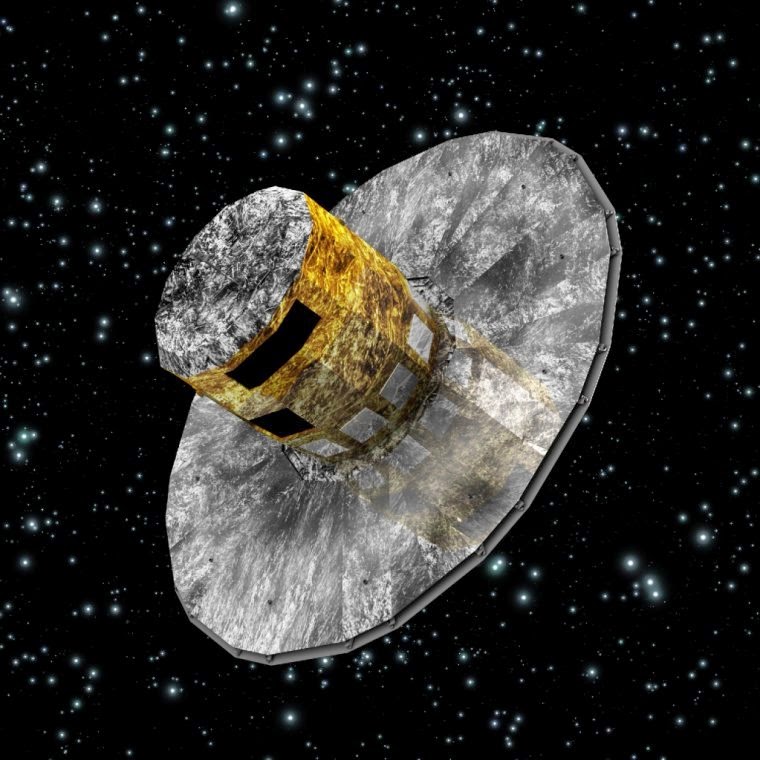
To measure parallaxes for stars across the entire sky requires a dedicated space telescope designed to make the most precise positional measurements of as many stars as possible. The telescope designed to do this is Gaia, the European Space Agency's (ESA) current flagship mission.

An artist's impression of ESA's Gaia Satellite
(Credit: ESA)
Gaia has been 20 years in development, planned since the final days of it's predecessor, the Hipparcos satellite, which measured the positions of the brightest 100,000 stars in the sky. It represented a giant leap forward in astrophysics, providing accurate distances for a large number of stars for the first time, but in some respects it barely scratched the surface of our galaxy.

Our Galaxy is approximately 100,000 light years across and contains roughly 100 billion stars. While Hipparcos was revolutionary, it observed only a fraction of the stars in our galaxy out to distances of only about 3000 light years. Gaia's goal is to surpass this and provide the first detailed, structural map of our entire galaxy.

Gaia will achieve this by imaging the entire sky repeatedly, approximately 70 times over the 5 year mission of the satellite. With each scan the satellite will record the positions of all the stars it observes, allowing scientists on Earth to measures the parallaxes and therefore the distances to all these stars.

But Gaia doesn't just measure the parallax towards these stars but also their motion across the sky, known as their proper motion. The stars in the sky are not fixed, but constantly moving and Gaia can measure these movements using the images it takes over the satellite's lifetime.

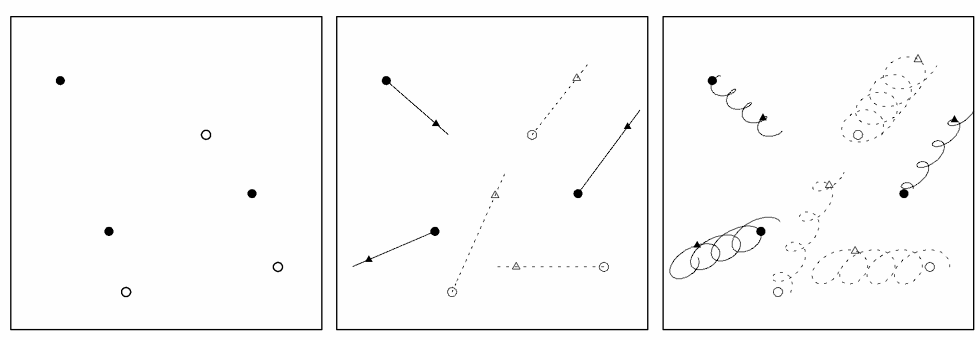
In fact Gaia needs to measure both the proper motion and the parallax of the stars because when the two are combined they cause the stars to follow a unique apparent motion across the sky. The figure below shows this. On the left you can see the positions of the stars that you might see from a single image of the night sky. Add in their motions across the sky (their proper motions) and the stars will follow straight paths (shown in the central panel), but then add in the parallax effect and the stars will appear to trace out loops across the sky (see the right-hand panel).

The apparent motions of the stars built up from their positions (left), proper motions (centre) and parallaxes (right)
(Credit: Wikipedia)

The complicated paths traced by the stars are the reason Gaia needs to perform so many astrometric measurements, allowing scientists to separate the motions due to parallax and proper motion.

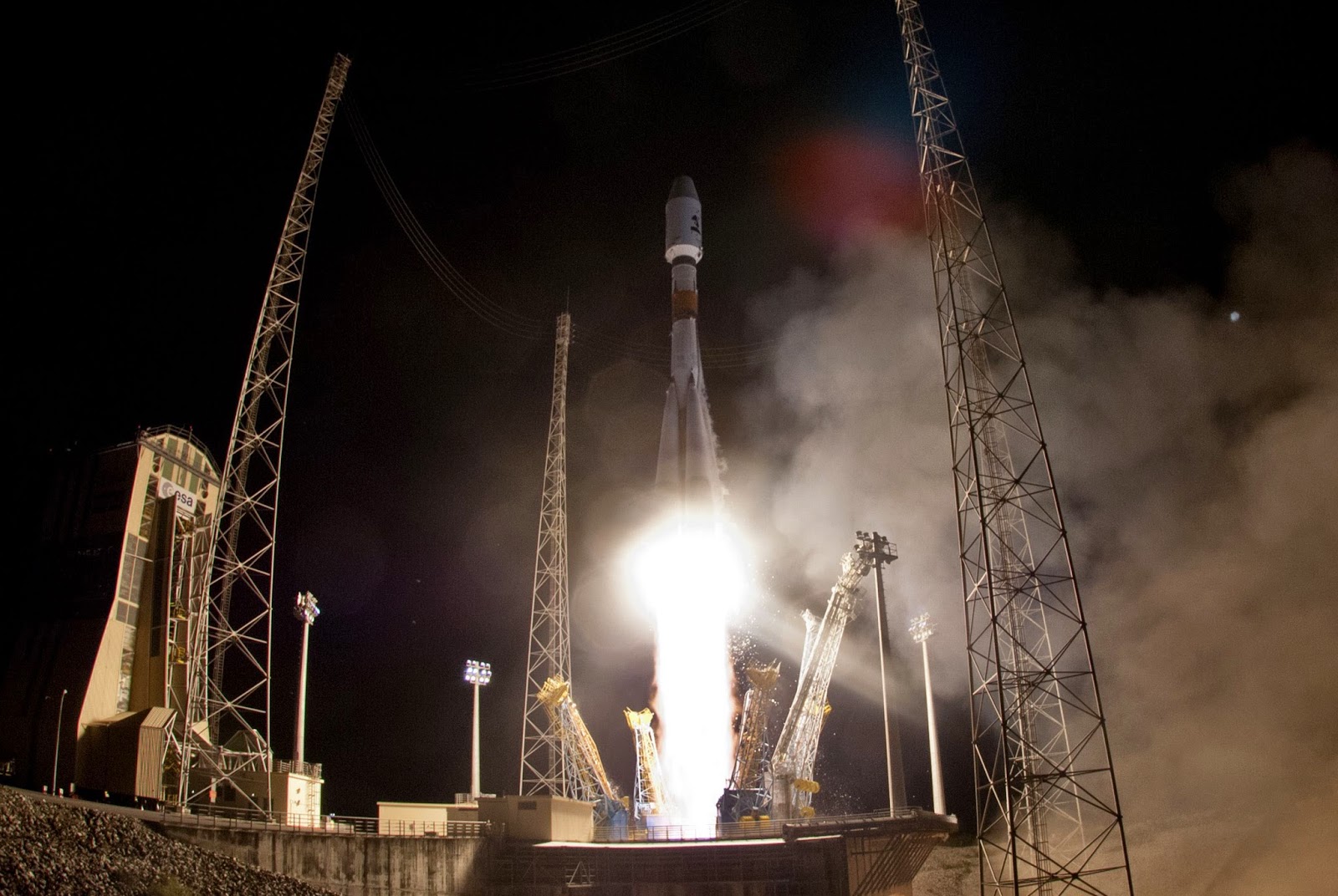
The Gaia satellite was launched in December 2013 on a Soyuz rocket from ESA's launch site in French Guiana, the Guiana Space Centre. After a successful launch the satellite was manoeuvred to its designated orbital position, known as L2.

Gaia's launch aboard a Soyuz rocket (Credit: Japan Times)

Once the satellite's mission is over scientists will be able to determine the parallaxes and proper motions of approximately 1 billion objects, as well as other useful information such as their colours and some spectroscopic information.

This detailed and important information, for so many stars will revolutionise astronomy. For the first time we will be able to map out the 3-dimensional structure of our Galaxy and we'll finally know the true distances to so many interesting astronomical objects (including star clusters!), allowing us to know where they are in our Galaxy, how they're moving, and how luminous they are.

I'm sure I'll be posting more news and information about Gaia in the future, so stay tuned!

Thursday, 11 December 2014

How far away is that star?

One of the simplest and yet most important questions in astronomy relates to how far away the objects we study are. This question is relevant to all astronomical objects, from stars to galaxies and beyond. It's important to understand how far away these objects are because that's how we know how large or how luminous they are, and knowing these characteristics is necessary to build up our model of the Universe.

Despite this, measuring distances in astronomy is incredibly difficult, because sometimes all that can be resolved about an object is a single dot of light. For this reason astronomers have built up a series of methods for estimating the distances to objects, each of which is used for different types of object at different distances, and with each method calibrated using one of the other methods. We refer to this as the distance ladder.

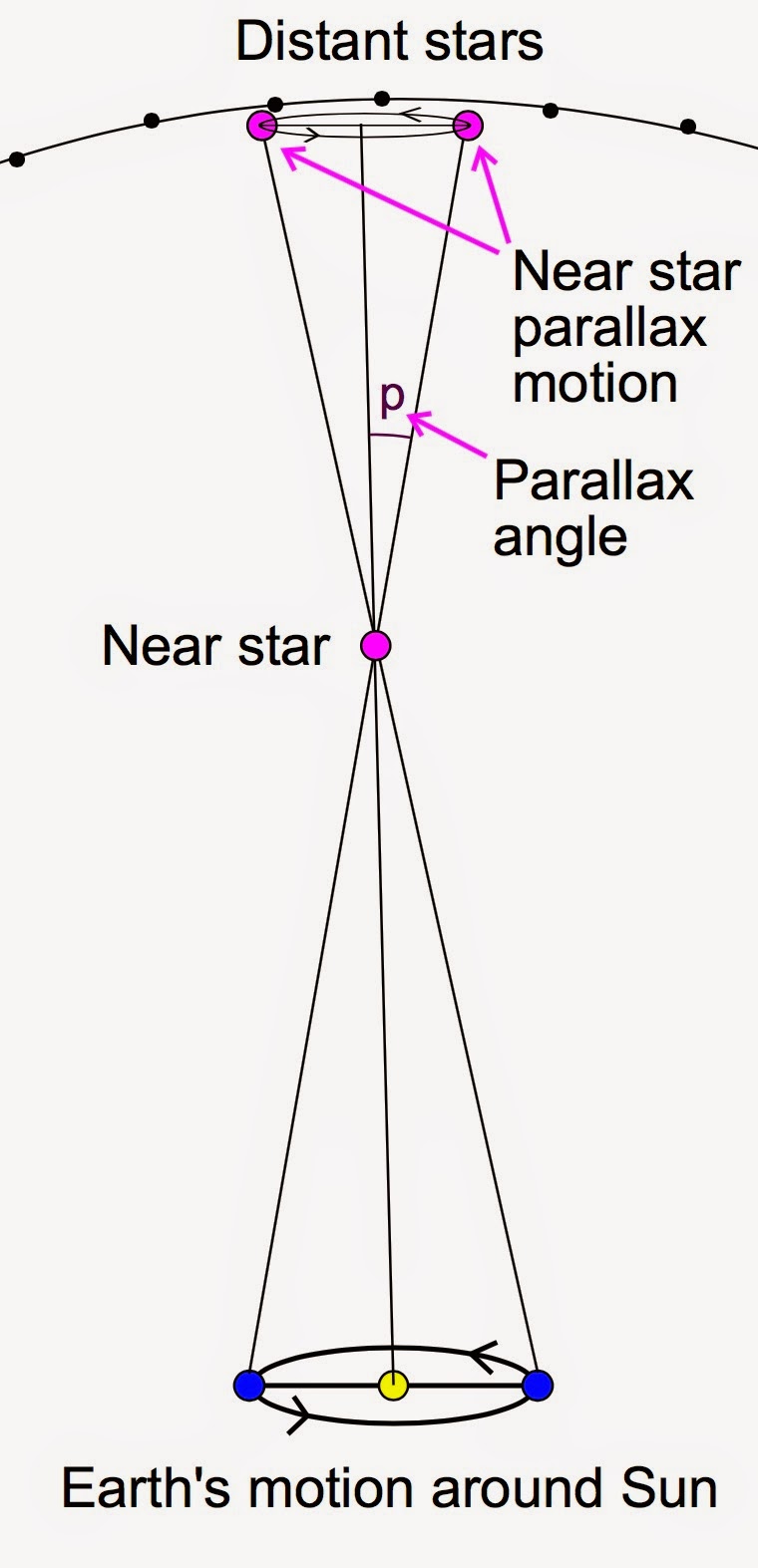
The Parallax Effect
(Credit: Wikipedia)
The most fundamental method to determine distance, and the most important step on the distance ladder, is known as parallax. Parallax is the effect by which objects at different distances change their apparent position based on your vantage point.

In astronomy this is possible because the Earth changes it's position throughout the year as it orbits the Sun. Because of this the apparent positions of stars relative to each other change throughout the year.

This diagram shows an example of this. When the Earth is on the opposite side of the Sun the line of sight to a nearby star will change relative to more distant stars. The apparent shift in the position of the nearby star is known as the parallax angle and is directly related to the distance to the star - the nearer the star is, the larger the parallax angle will be.

You can simulate a small-scale version of this process for yourself using your two eyes as the two different vantage points. Hold out your hand in front of your face with a single finger pointing vertically upwards. Close one eye and look at the scene in front of you. Then switch the eye that is closed and see how the scene in front of you changes. You should see that the position of your finger changes relative to the background scene it is projected against.

In this example your finger is the nearby star and the background scene is the background stars. If you try moving your finger closer or further away from your face you should see that the apparent shift in your finger's position when you switch your closed eye changes - does the shift get larger when your finger is closer or further away from you?

Because parallax is such an important method of distance determination it has led to the most commonly used unit of distance in astronomy, the parsec. A parsec (1 pc) is the distance at which an object's apparent position shifts by 1 second of arc (1/3600 of a degree) as the Earth orbits the Sun. It's a very small shift, but then a parsec is a very large distance - approximately 30,000,000,000,000 km!

Despite how big the parsec is, all the stars in the sky are actually more distant than a parsec, and many are much much further than this. Because of this astronomers need very precise instruments and telescopes to be able to measure the tiny changes that result from the parallax effect. One of the most famous such telescopes was the Hipparcos space telescope, which measured parallaxes for thousands of stars out to distances of several hundred parsecs. The Hipparcos telescope was one of the most important telescopes in astrophysics, simply because of the unprecedented accuracy with which it measured the distance to so many stars. The successor to Hipparcos, the Gaia space telescope, was launched about a year ago, and is continuing this mission as we speak.

The European Space Agency's Hipparcos satellite (Credit: CNES)

For very distant objects where the parallax method is not feasible the only way to determine distances is to estimate how intrinsically bright the object is and then determine its distance based on how bright it appears to us. To do this we need to use objects with a known, or predictable, brightness, often referred to as standard candles. Examples of this including pulsating stars such as Cepheid variables, which Edwin Hubble used to determine distances to other galaxies. This method is most commonly applied to distant galaxies that are too far away to use parallax, but close enough to resolve and study their individual stars.