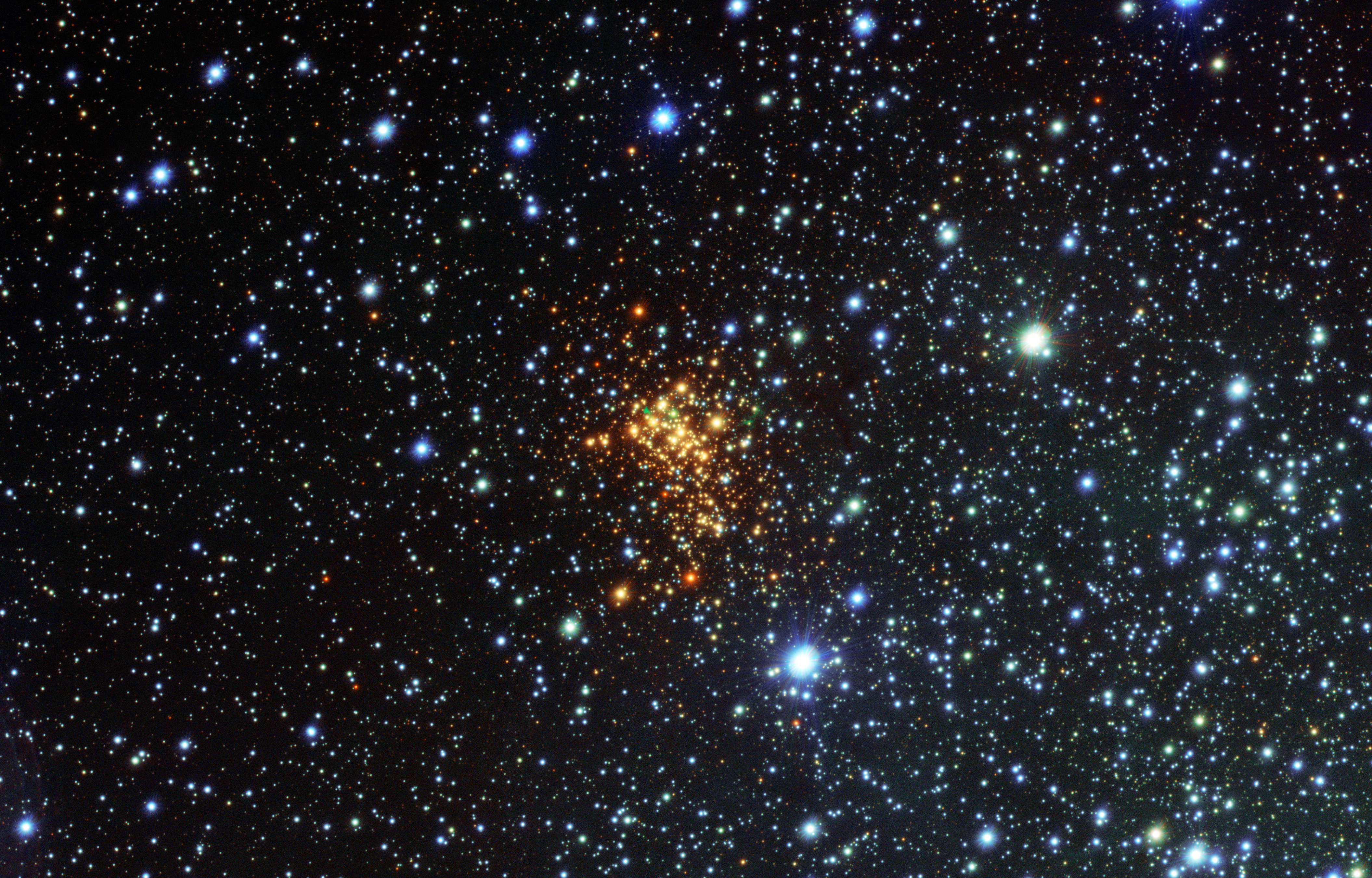
So it's observing proposal season and Wednesday was the ESO deadline, which means panicked proposal writing and last-minute scribbling all round.
ESO is the European Southern Observatory, Europe's premier observatory in the southern hemisphere, which operates some of the largest and most advanced telescopes in the world. This includes the four behemoths that make up the VLT, the Very Large Telescope (except there's four of them), each housing a 8.2m mirror and some of the best astronomical instruments in the world.
One of the proposals we submitted is part of work by my colleague Mike Mohr-Smith to improve the census of massive stars in our galaxy and identify where they formed. Massive stars are very rare and live very short lives (on astronomical timescales at least), but affect the evolution of other stars and the galaxy as a whole in very important ways. How massive stars form is a major unanswered question in astronomy, and since they live such short lives finding these stars and tracing them back to their birth-sites is an important avenue of research.
So we've recently identified a number of hitherto-undiscovered massive stars in the vicinity of one of the young massive star clusters in our galaxy, Westerlund 2. The most massive stars we know of are nearly always found deep within star clusters, and some people have suggested that they can only form in such environments, so finding massive stars near a massive star cluster, but not within it, is very interesting.
So the question arises, did these stars form outside of the cluster (which would make them very special) or did they form in the cluster but have since been ejected? The first step in answering this question is to measure the speed these stars are moving relative to the cluster. If the stars have been ejected (known as runaway stars) they should be moving very fast away from the cluster, but if they formed in isolation their velocities will be much lower.
By taking high resolution spectroscopy of these stars we can measure their speeds by observing the shifts in the positions of known spectral lines due to the Doppler effect. This is the same effect that causes the pitch of a siren to change as a vehicle moves towards you and then away from you, but instead of affecting sound waves it is shifting light waves.
This image shows a spectrum of light, which is light split into its constituent parts using a prism. What was originally white light has now been split into all the colours of the rainbow (it's actually the same effect that causes a rainbow!).
On top of the rainbow you can see dark lines, which are known as spectral lines. These are caused by atoms of different elements absorbing light at certain wavelengths (in certain parts of the spectrum). When an object is moving away from us, it's light is redshifted, meaning spectral lines shift towards the red part of the spectrum, while when an object is moving towards us it's light is blueshifted, meaning spectral lines shift towards the blue part of the spectrum. The faster an object is moving relative to us, the greater the shift in the position of the spectral lines. So by observing the spectrum of light from a star, measuring the positions of it's spectral lines and comparing them to the positions we know they should be at we can determine how fast the star is moving towards or away from us.
So our objective is to use one of the instruments on the VLT to acquire high-resolution spectroscopy, measure the positions of the spectral lines and therefore the speed the stars are moving relative to the stars in the cluster. With this information we can answer the question of whether these very massive stars formed inside the cluster or outside of the cluster.
That's our plan at least, and that's what we've written to the friendly people at ESO asking them if we can use their telescope to do this project. I'll let you know what they say!
ESO is the European Southern Observatory, Europe's premier observatory in the southern hemisphere, which operates some of the largest and most advanced telescopes in the world. This includes the four behemoths that make up the VLT, the Very Large Telescope (except there's four of them), each housing a 8.2m mirror and some of the best astronomical instruments in the world.
 |
| ESO's Very Large Telescope(s) in Chile (Credit: Wikimedia Commons) |
One of the proposals we submitted is part of work by my colleague Mike Mohr-Smith to improve the census of massive stars in our galaxy and identify where they formed. Massive stars are very rare and live very short lives (on astronomical timescales at least), but affect the evolution of other stars and the galaxy as a whole in very important ways. How massive stars form is a major unanswered question in astronomy, and since they live such short lives finding these stars and tracing them back to their birth-sites is an important avenue of research.
So we've recently identified a number of hitherto-undiscovered massive stars in the vicinity of one of the young massive star clusters in our galaxy, Westerlund 2. The most massive stars we know of are nearly always found deep within star clusters, and some people have suggested that they can only form in such environments, so finding massive stars near a massive star cluster, but not within it, is very interesting.
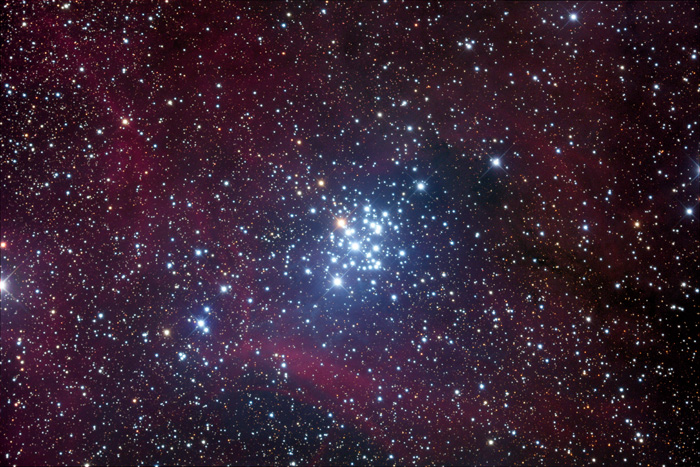 |
| The massive star cluster Westerlund 2 (Credit: Robert Gendler) |
So the question arises, did these stars form outside of the cluster (which would make them very special) or did they form in the cluster but have since been ejected? The first step in answering this question is to measure the speed these stars are moving relative to the cluster. If the stars have been ejected (known as runaway stars) they should be moving very fast away from the cluster, but if they formed in isolation their velocities will be much lower.
By taking high resolution spectroscopy of these stars we can measure their speeds by observing the shifts in the positions of known spectral lines due to the Doppler effect. This is the same effect that causes the pitch of a siren to change as a vehicle moves towards you and then away from you, but instead of affecting sound waves it is shifting light waves.
 |
| Representation of the Doppler-shift effect on spectral lines (Credit: University of Virginia) |
On top of the rainbow you can see dark lines, which are known as spectral lines. These are caused by atoms of different elements absorbing light at certain wavelengths (in certain parts of the spectrum). When an object is moving away from us, it's light is redshifted, meaning spectral lines shift towards the red part of the spectrum, while when an object is moving towards us it's light is blueshifted, meaning spectral lines shift towards the blue part of the spectrum. The faster an object is moving relative to us, the greater the shift in the position of the spectral lines. So by observing the spectrum of light from a star, measuring the positions of it's spectral lines and comparing them to the positions we know they should be at we can determine how fast the star is moving towards or away from us.
So our objective is to use one of the instruments on the VLT to acquire high-resolution spectroscopy, measure the positions of the spectral lines and therefore the speed the stars are moving relative to the stars in the cluster. With this information we can answer the question of whether these very massive stars formed inside the cluster or outside of the cluster.
That's our plan at least, and that's what we've written to the friendly people at ESO asking them if we can use their telescope to do this project. I'll let you know what they say!