Monday, 22 December 2014

Globular Clusters: the grandaddies of all clusters

This week I heard a fascinating talk about globular clusters, so I wanted to take this opportunity to tell you about globular clusters, and some of the science being done to study and better understand these amazing astronomical objects.

Globular clusters are a type of star cluster, but they're a very special type of star cluster, partly because they're very massive, but also because they're very old, almost as old as the Universe itself. For this reason they provide a glimpse of how stars, and star clusters, formed a long time ago.


The Omega Centauri globular cluster, the largest in
our galaxy (Credit: ESO)
Globular clusters are huge and contain millions of stars, considerably more than other types of star cluster. Although there are no fixed boundaries for the size of a globular cluster, they typically contain between 100 thousand and a few million stars, though there are some even larger than this.

The largest globular cluster in our galaxy is Omega Centauri, which is thought to contain approximately 10 million stars. Though it is quite distant it is relatively bright and can be seen with a pair of binoculars, as can many of the other globular clusters in our galaxy.

In addition to being massive, globular clusters are also very old. The ages of globular clusters can be determined by studying how the stars in the cluster have evolved based on our understanding of stellar evolution (the study of how stars evolve). The globular clusters in our galaxy seem to be about 11-13 Gyr old (1 Gyr = 1000 million years). This is just younger than the approximate age of the Universe, 13.7 Gyr, suggesting globular clusters were some of the first objects to form in the Universe.

The M80 'Scorpio' globular cluster (Credit: Baran Observatory)

It is thanks to their old age that globular clusters are so round and spherical. Globular clusters are held together by the mutual gravitational attraction of all the stars in the cluster, and over time this gravitational attraction has smoothed out any small structural differences in the cluster and created an almost perfect ball of stars. In fact globular clusters are really useful for studying how gravity affects clusters of stars, simply because they've been around for so long and have been relatively undisturbed by the galaxy.

The reason globular clusters haven't been disturbed by the galaxy they reside within is because of where within the galaxy globular clusters are found. The oldest stars in our galaxy are found not in the disk of the Milky Way galaxy, but in its halo, which is a spherical and diffuse cloud of stars within which the disk of our galaxy sits. Globular clusters are as old as the oldest stars in our galaxy and are found distributed across the Galactic halo in relative isolation compared to the spiral-shaped disk of the galaxy.

The structure of our galaxy, showing the globular clusters in the Galactic halo (Credit: University of Oregon)

Our galaxy contains approximately 150 known globular clusters, with experts suggesting that there may be 10 to 20 still to be discovered. Because of their brightness we can identify globular clusters in other galaxies and some large galaxies have many more globular clusters than the Milky Way, for example the Andromeda Galaxy may have as many as 500 globular clusters!

One of the great mysteries of globular clusters is how they formed, whether they formed in a single burst of star formation or whether they are made up of multiple generations of stars. This also raises the question of whether globular clusters are significantly different from some of the smallest type of galaxy we know of, for example the dwarf spheroidal galaxies. All of these unanswered questions are very important for understanding how stars and galaxies form, which makes globular clusters an important area of astronomical research.

Thursday, 11 December 2014

How far away is that star?

One of the simplest and yet most important questions in astronomy relates to how far away the objects we study are. This question is relevant to all astronomical objects, from stars to galaxies and beyond. It's important to understand how far away these objects are because that's how we know how large or how luminous they are, and knowing these characteristics is necessary to build up our model of the Universe.

Despite this, measuring distances in astronomy is incredibly difficult, because sometimes all that can be resolved about an object is a single dot of light. For this reason astronomers have built up a series of methods for estimating the distances to objects, each of which is used for different types of object at different distances, and with each method calibrated using one of the other methods. We refer to this as the distance ladder.

The Parallax Effect
(Credit: Wikipedia)
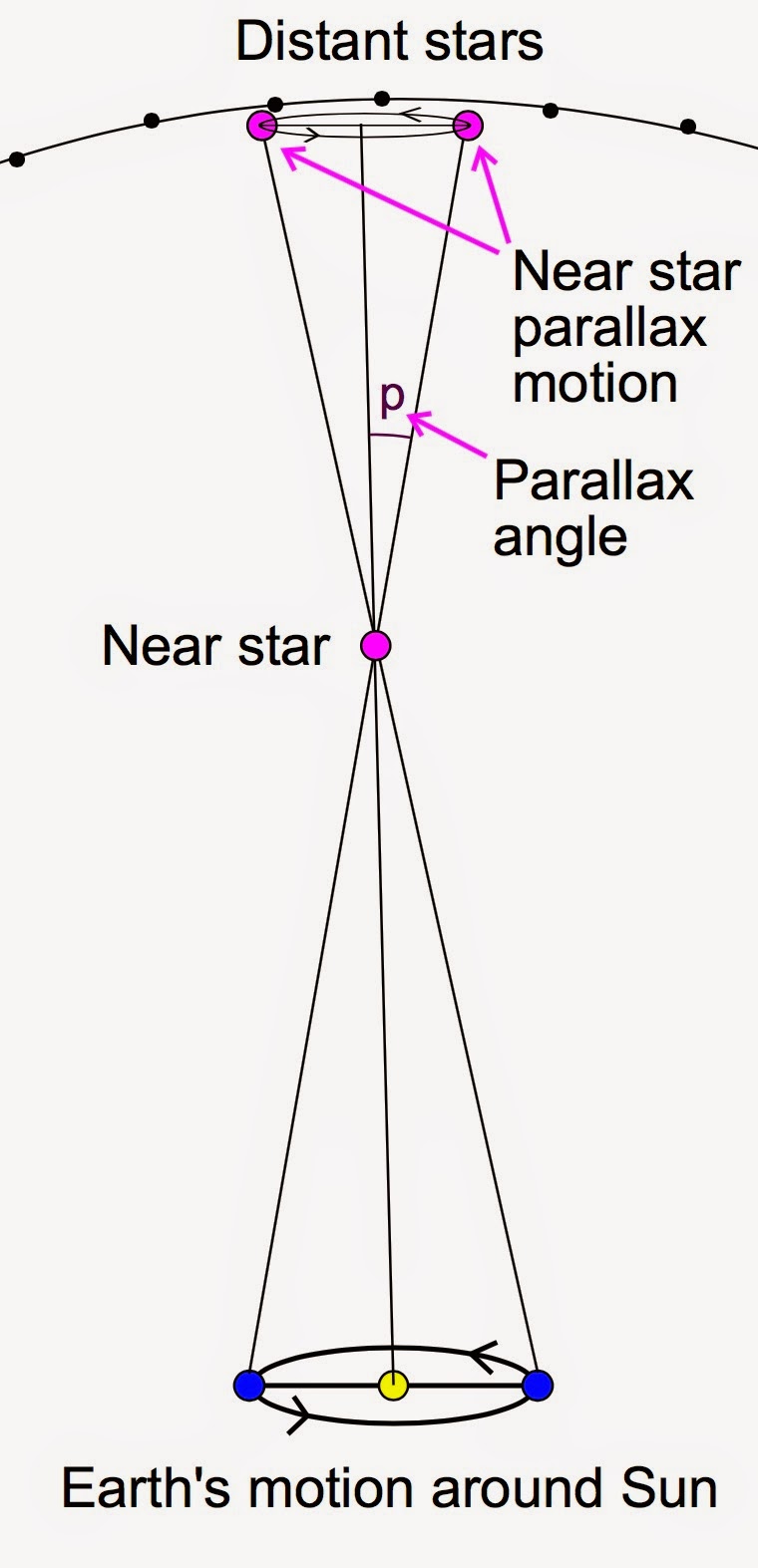
The most fundamental method to determine distance, and the most important step on the distance ladder, is known as parallax. Parallax is the effect by which objects at different distances change their apparent position based on your vantage point.

In astronomy this is possible because the Earth changes it's position throughout the year as it orbits the Sun. Because of this the apparent positions of stars relative to each other change throughout the year.

This diagram shows an example of this. When the Earth is on the opposite side of the Sun the line of sight to a nearby star will change relative to more distant stars. The apparent shift in the position of the nearby star is known as the parallax angle and is directly related to the distance to the star - the nearer the star is, the larger the parallax angle will be.

You can simulate a small-scale version of this process for yourself using your two eyes as the two different vantage points. Hold out your hand in front of your face with a single finger pointing vertically upwards. Close one eye and look at the scene in front of you. Then switch the eye that is closed and see how the scene in front of you changes. You should see that the position of your finger changes relative to the background scene it is projected against.

In this example your finger is the nearby star and the background scene is the background stars. If you try moving your finger closer or further away from your face you should see that the apparent shift in your finger's position when you switch your closed eye changes - does the shift get larger when your finger is closer or further away from you?

Because parallax is such an important method of distance determination it has led to the most commonly used unit of distance in astronomy, the parsec. A parsec (1 pc) is the distance at which an object's apparent position shifts by 1 second of arc (1/3600 of a degree) as the Earth orbits the Sun. It's a very small shift, but then a parsec is a very large distance - approximately 30,000,000,000,000 km!

Despite how big the parsec is, all the stars in the sky are actually more distant than a parsec, and many are much much further than this. Because of this astronomers need very precise instruments and telescopes to be able to measure the tiny changes that result from the parallax effect. One of the most famous such telescopes was the Hipparcos space telescope, which measured parallaxes for thousands of stars out to distances of several hundred parsecs. The Hipparcos telescope was one of the most important telescopes in astrophysics, simply because of the unprecedented accuracy with which it measured the distance to so many stars. The successor to Hipparcos, the Gaia space telescope, was launched about a year ago, and is continuing this mission as we speak.

The European Space Agency's Hipparcos satellite (Credit: CNES)

For very distant objects where the parallax method is not feasible the only way to determine distances is to estimate how intrinsically bright the object is and then determine its distance based on how bright it appears to us. To do this we need to use objects with a known, or predictable, brightness, often referred to as standard candles. Examples of this including pulsating stars such as Cepheid variables, which Edwin Hubble used to determine distances to other galaxies. This method is most commonly applied to distant galaxies that are too far away to use parallax, but close enough to resolve and study their individual stars.

Wednesday, 26 November 2014

Surveys, surveys, surveys

I have been in Naples, Italy, this week for a conference about the many wonderful astronomical surveys that have been produced recently. The last decade has been a rich time for survey science, thanks in part to the pioneering surveys at the turn of the century (such as SDSS and 2MASS), but also to the work of new dedicated survey telescopes such as VST and VISTA. These large surveys have provided astronomers with huge samples of stars and galaxies with which to investigate many important aspects of how stars and galaxies form and evolve.

The European Southern Observatory's (ESO) facilities at Cerro Paranal,
including the VLT, VST and VISTA telescopes (Credit: Wikipedia)
It is with one of these telescopes, the VLT Survey Telescope (VST), that I have been using data from over the last few years for the VPHAS+ survey, the VLT Photometric H-Alpha Survey. This is the follow-up survey to IPHAS, the INT Photometric H-Alpha Survey, which I discussed in a previous post.

The VPHAS+ survey was actually the subject of the talk I gave at the conference today. I presented both an outline of the survey and some of the most exciting science results that have come out of the survey in recent years. It was quite an honour to present so much exciting science from across our survey collaboration, and I'm grateful to everyone in the survey who contributed to the work and helped me prepare the presentation. If you want to learn more you can watch my presentation on youTube here (my talk starts at 56:00).

This conference has been a great opportunity to learn both about surveys going on at the moment and some of the surveys planned for the future. As well as the traditional photometric surveys, there are now surveys designed to study how astronomical objects change over time by making repeat observations of the same areas of the sky. Some surveys are already doing excellent work in this area, such as the VVV survey (Vista Variables in the Via Lactae), but there are also some very exciting projects planned for the future, such as the Large Synoptic Survey Telescope (LSST).

Finally, there have been looks to the future of astronomical surveys and particularly the future spectroscopic surveys that will, instead of just measuring the brightness of sources in a few bands, actually take detailed spectra that can be used to determine the physical properties of the sources. The European Southern Observatory, ESO, has plans to convert one of its survey telescopes, VISTA, from being an imaging telescope to being a spectroscopic telescope. This is something that I really look forward to seeing and hopefully using. These are really exciting times for survey astronomy!

Thursday, 13 November 2014

How our galaxy absorbs other galaxies


I want to take a break from talking about star clusters today to discuss something on a much larger scale: our galaxy! This is motivated by a visit yesterday from Dr Vasily Belokurov from Cambridge University who gave an excellent seminar on the size and structure of our galaxy from studies of how our galaxy grows.

Large galaxies like our Milky Way galaxy can grow by absorbing smaller dwarf galaxies. These dwarf galaxies are common in the Universe and when they get close to a massive galaxy like ours they are drawn towards it by gravity and begin to orbit the larger galaxy (they're often called satellite galaxies at this point).

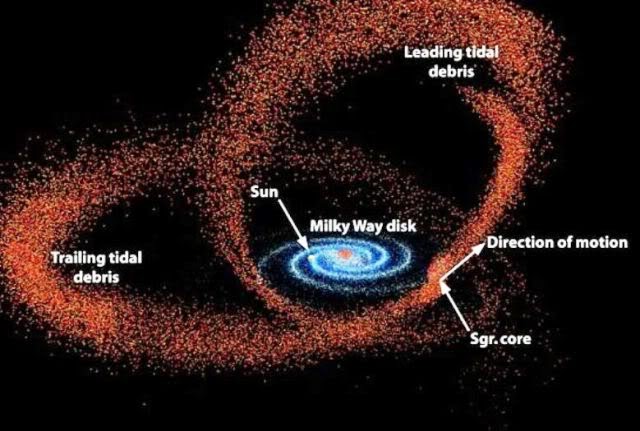
When these small galaxies get really close to the large galaxy they begin to be disrupted by the gravitational force from the larger galaxy and can actually be torn to shreds, scattering the stars in the dwarf galaxy out into long tidal streams, as shown in the image below.

Tidal streams caused by orbiting satellite galaxies (Credit: David Law)

This process can take millions of years while the dwarf galaxy orbits and falls into the larger galaxy. This creates patterns of huge tidal streams emanating from these satellite dwarf galaxies and which encircle our own galaxy.

A famous example of this is the Sagittarius dwarf galaxy, which is about 82,000 light years from us and in the process of being stripped apart as it orbits the Milky Way. We can see this as a huge stream of stars that circles the sky known as the Sagittarius tidal stream. The image below shows this stream (and other streams) using data from the Sloan Digital Sky Survey - which we talked about in a previous post. The Milky Way will one day consume this galaxy entirely, absorbing all of its stars into the halo of our galaxy.

The Sagittarius Tidal Stream as seen in SDSS data (Credit: Vasily Belokurov)

Dr Belokurov studies tidal stream such as this to infer the large-scale structure of our galaxy. Because we are inside our galaxy it can be hard to determine it's full size and spatial extent, so this can be difficult work. This approach is kind of like inferring the structure of a city by tracing the motions of cars entering the city - even if you don't know where the buildings and places of interest are, you would be able to estimate where they are and how the city is structured by the motions of cars into and around the city. This is exactly what Dr Belokurov does, only by using the positions and motions of tidal streams he can infer the structure of the galaxy!

Sunday, 9 November 2014

Talking about star clusters in Copenhagen

The absence of posts this week was because I've been taking a break from doing research at my desk and instead I've been at a conference to discuss research with other scientists studying star clusters. The conference was "The Early Life of Stellar Clusters: Formation and Dynamics" and was held in Copenhagen, Denmark, a really beautiful city.

Copenhagen, very pretty (albeit cold)

Conferences are important in science because they allow scientists distributed all over the world to come together and discuss the current state of research with other scientists. This can be particularly important if you work in a small field (such as astrophysics) where the world's experts are spread all around the world. There can be lots of debates and arguments, discussions with collaborators, as well as opportunities to start new collaborations with people you meet.

This meeting attracted about 50 people who all study different aspects of star clusters and who have come together to discuss them. Most of the attendees have given a presentation to the group, including myself (I gave my talk on the first day and was able to relax after that). I talked about my recent work on an OB association called Cygnus OB2 (more on that in a future post) and I think it was well received.

It was a great conference and I'm very grateful to the organisers for putting it together (and for giving me the opportunity to present my work!). The meeting has given me lots of ideas for future projects, has opened the door to future collaborations, and helped develop some existing projects. I'm looking forward to the next conference already!