Tuesday, 17 February 2015

Where the wild things are: Cygnus OB2

This week I want to tell you about one of my favourite astronomical objects, and one which I have spent many years studying, the Cygnus OB2 association.

Cygnus OB2 is a loose group of young stars known as an association, a sort of less-dense version of a star cluster. As the name would suggest, the Cygnus OB2 association is the 2nd OB association catalogued in the constellation of Cygnus. This constellation lies very prominently in the plane of our galaxy where the majority of stars and nearly all young stars in our galaxy are found.

The Milky Way, showing the constellation of Cygnus and the position of the Cygnus OB2 association
(Original image credit: Axel Mellinger)

From the image above you wouldn't believe anything particularly exciting was happening in Cygnus, as the region appears mostly dark, particularly around Cygnus OB2 itself. The reason for this is that between us and Cygnus OB2 there is a vast cloud of obscuring dust that absorbs the majority of starlight emitted by the association, hiding it from us. This cloud of dust is sometimes referred to as the Cygnus Rift or the Great Rift, and can be seen extending across much of the Galactic Plane, as the above image shows.

Optical photons are readily absorbed by dust particles, but infrared photons are less susceptible to this problem and can penetrate these obscuring dust clouds. An infrared view of the Galactic Plane, such as that shown below thanks to Japan's Akari satellite, reveals the prominent sites of star-formation activity in our galaxy, radiating brightly thanks to the many young stars forming within them.

The Milky Way in infrared light, as seen by the Akari satellite, with major infrared-bright regions labelled
(Credit: ESA)

The brightest and most prominent of all these star forming regions is probably the Cygnus region, despite it being more distant than many of the other star forming regions shown on this image. This brightness is testament to the intense amount of star formation that has, and still is occurring in this region. In fact when this region was first studied at radio wavelengths the bright structure was so prominent as to be marked with an 'X', hence leading to the name of Cygnus X for the whole star forming complex.

Detailed infrared view of the Cygnus X region, with
Cygnus OB2 in the centre (Credit: NASA)
Zooming into this image we can begin to see some of the amazing structures present within the Cygnus X giant molecular cloud. Vast clouds of gas and dust can be seen collapsing to form young stars, while huge pillars are constantly being sculpted and eroded by the recently-formed stars. This is a place where star formation takes place at the extremes!

Right in the centre of the Cygnus X giant molecular cloud is the Cygnus OB2 association, a massive group of young stars, as populous as some of the most massive young star clusters in our galaxy, yet nowhere near as compact.

The diffuseness of Cygnus OB2, coupled with the obscuring dust clouds, led to it being maligned for many decades. Only in the last 15 years, thanks to the revolutions in infrared and X-ray astronomy, have researchers been able to penetrate the extinction and uncover the thousands of massive, young stars in this huge OB association, including some of the most massive and luminous stars known!

As I said at the beginning of this post, Cygnus OB2 is a region I have studied for many years, hoping to better understand its origins and its content, and therefore to appreciate its role in the continual evolution of our galaxy. Next week I hope to share some exciting news and discoveries about Cygnus OB2 that we will be publishing very soon, so stay tuned!

Sunday, 1 February 2015

Where stars form

Yesterday we were treated to a stunning image on the Astronomy Picture of the Day website, which showed off one of the regions in our galaxy where stars are in the process of forming. The image is shown below in infrared light, using data from NASA's Spitzer Space Telescope.

The W33 star forming region as seen in infrared light (Credit: NASA / Spitzer Space Telescope)

This region is called W33, so called because it was the 33rd object catalogued by Gart Westerhout in his survey of radio sources in our Galaxy. Many of the sources catalogued by Westerhout are regions in which stars are forming, such as this one.

Astronomers refer to these regions as massive star forming regions, not just because they are massive (this image is about 100 light years wide!), but also because they are the sites where massive stars are forming. Massive stars are the hottest and most luminous stars that exist, and they play an important role in how a galaxy evolves thanks to their luminosity, the strong winds that emanate from their surfaces, and the supernova explosions in which they end their lives.

For these reasons, and because of their short lives and inherent rarity, massive stars are important objects to study. Furthermore astronomers aren't entirely sure how they form, so regions such as this where massive stars are known to be forming, are important to study.

Friday, 23 January 2015

Another opportunity to name something in astronomy!


Following my post a few weeks ago about an opportunity from NASA to name some of the newly discovered craters on Mercury it has been great to hear some of the suggestions you've put forward.

If you missed out on this opportunity to name something in astronomy (sorry the deadline has now passed), but wanted to name something then I have good news for you, there's another opportunity!

The International Astronomical Union (IAU) wants your help to name exo-planets! Exoplanets are planets around stars other than our Sun. In the last decade astronomers have discovered hundreds of planets around nearby stars, thanks to dedicated instruments and space telescopes.

Would you like to name this exoplanet? (Credit: IAU)

The IAU is the governing body tasked with naming objects in the Universe and they want help from members of the public to name these exoplanets. Although people have been naming celestial objects for hundreds of years, the IAU has been given the task of assigning scientifically recognised names to newly discovered objects.

The IAU has called this the NameExoWorlds contest, and the first round of the competition is open to clubs and non-profit organisations from anywhere in the world. To participate in this competition all your club has to do is register with the IAU (which you can do here) and then submit your nominations. The first stage of the nomination process is to choose which new exoplanets to name (you can do this here), and then in the second stage the IAU will seek nominations for their names. Finally, once all the nominations are in the public will be allowed to vote for the nominated names.

But hurry, the deadline for the first stage of the competition is the 15th of February 2015!

Sunday, 11 January 2015

Gaia: ESA's billion star surveyor

In a recent post I talked about the different methods astronomers use to measure the distances to the stars, and how the parallax method is probably the most important of all of these as it is one of the few true measures of distance.

Parallax relies on being able to measure the precise positions of the stars on multiple occasions so that their changing positions can be measured as the Earth orbits the Sun. Measuring the positions of stars is known as astrometry, and represents an entire branch of astrophysics. Making precise position measurements is incredibly difficult and is possible using only the most advanced telescopes on Earth, and this is only possible for stars in small areas of the sky at a time.

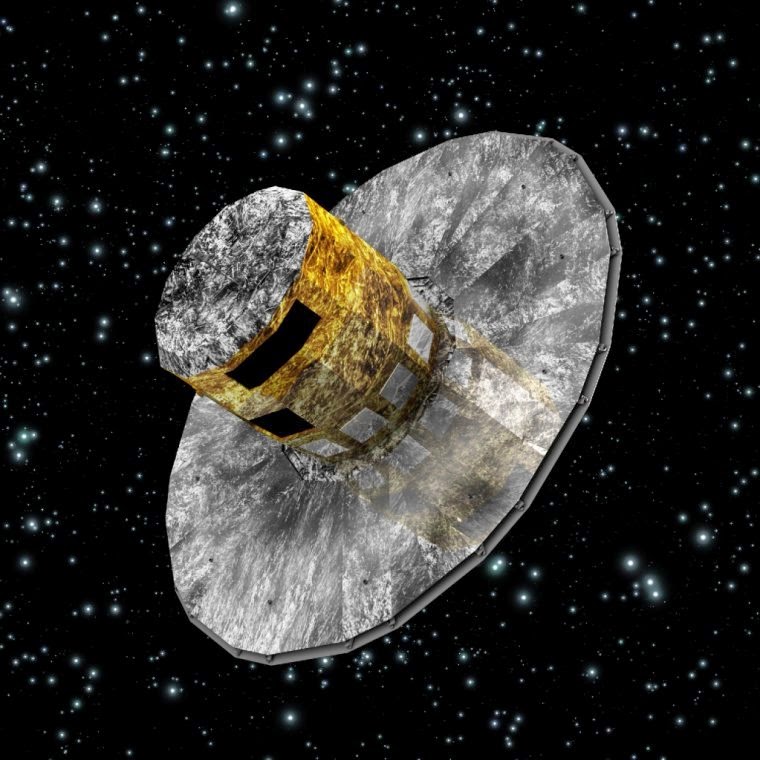
To measure parallaxes for stars across the entire sky requires a dedicated space telescope designed to make the most precise positional measurements of as many stars as possible. The telescope designed to do this is Gaia, the European Space Agency's (ESA) current flagship mission.

An artist's impression of ESA's Gaia Satellite
(Credit: ESA)
Gaia has been 20 years in development, planned since the final days of it's predecessor, the Hipparcos satellite, which measured the positions of the brightest 100,000 stars in the sky. It represented a giant leap forward in astrophysics, providing accurate distances for a large number of stars for the first time, but in some respects it barely scratched the surface of our galaxy.

Our Galaxy is approximately 100,000 light years across and contains roughly 100 billion stars. While Hipparcos was revolutionary, it observed only a fraction of the stars in our galaxy out to distances of only about 3000 light years. Gaia's goal is to surpass this and provide the first detailed, structural map of our entire galaxy.

Gaia will achieve this by imaging the entire sky repeatedly, approximately 70 times over the 5 year mission of the satellite. With each scan the satellite will record the positions of all the stars it observes, allowing scientists on Earth to measures the parallaxes and therefore the distances to all these stars.

But Gaia doesn't just measure the parallax towards these stars but also their motion across the sky, known as their proper motion. The stars in the sky are not fixed, but constantly moving and Gaia can measure these movements using the images it takes over the satellite's lifetime.

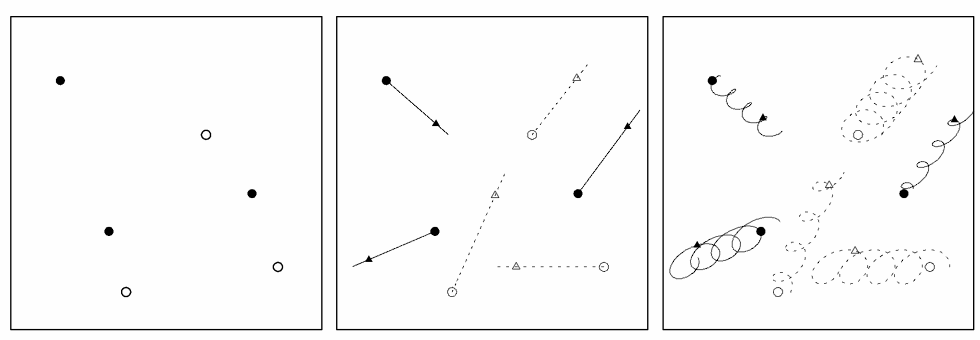
In fact Gaia needs to measure both the proper motion and the parallax of the stars because when the two are combined they cause the stars to follow a unique apparent motion across the sky. The figure below shows this. On the left you can see the positions of the stars that you might see from a single image of the night sky. Add in their motions across the sky (their proper motions) and the stars will follow straight paths (shown in the central panel), but then add in the parallax effect and the stars will appear to trace out loops across the sky (see the right-hand panel).

The apparent motions of the stars built up from their positions (left), proper motions (centre) and parallaxes (right)
(Credit: Wikipedia)

The complicated paths traced by the stars are the reason Gaia needs to perform so many astrometric measurements, allowing scientists to separate the motions due to parallax and proper motion.

The Gaia satellite was launched in December 2013 on a Soyuz rocket from ESA's launch site in French Guiana, the Guiana Space Centre. After a successful launch the satellite was manoeuvred to its designated orbital position, known as L2.

Gaia's launch aboard a Soyuz rocket (Credit: Japan Times)

Once the satellite's mission is over scientists will be able to determine the parallaxes and proper motions of approximately 1 billion objects, as well as other useful information such as their colours and some spectroscopic information.

This detailed and important information, for so many stars will revolutionise astronomy. For the first time we will be able to map out the 3-dimensional structure of our Galaxy and we'll finally know the true distances to so many interesting astronomical objects (including star clusters!), allowing us to know where they are in our Galaxy, how they're moving, and how luminous they are.

I'm sure I'll be posting more news and information about Gaia in the future, so stay tuned!

Friday, 2 January 2015

Ever wanted to name something in astronomy?

Have you ever wanted to name a star? Or a planet? Or maybe a whole galaxy? Maybe you paid someone to name a star for you and even received an offical-looking certificate in the post to prove it, only to then find out that no-one actually used your name.

Well if this sounds familiar, then I have some good news for you! The International Astronomical Union (IAU) has launched a competition to officially decide names for five new impact craters discovered on the planet Mercury, and they need your help to do this!

A map of Mercury's surface taken by the MESSENGER spacecraft, showing all the impact craters (Credit: NASA)

The impact craters were discovered by NASA's MESSENGER spacecraft, which has been orbiting the planet Mercury since March 2011. The spacecraft is only the second mission to successfully reach Mercury, and is the first to orbit the planet, which is quite an achievement due to how close Mercury is to the Sun!

The mission has been an immense success. Since the spacecraft arrived in orbit around Mercury four years ago it has been continually studying and imaging the planet's surface. Using these images scientists have discovered many new features on the surface of Mercury that were previously unknown, including lots of new impact craters.

It is important that these craters, which are of great scientific interest, be named in the long-held tradition of naming astronomical objects and features. Impact craters on Mercury are traditionally named after important people in the arts and humanities from anywhere in the world.

So the IAU would like your help in nominating who to name these craters after. According to their rules they will accept nominations for names of people in the arts and humanities who have been famous for at least 50 years and have been dead for at least 3 years (so no self-nominations unfortunately). You can find a list of existing named craters on Mercury here.

You can submit your nomination here: http://namecraters.carnegiescience.edu. Nominations are open until 15 January 2015.